
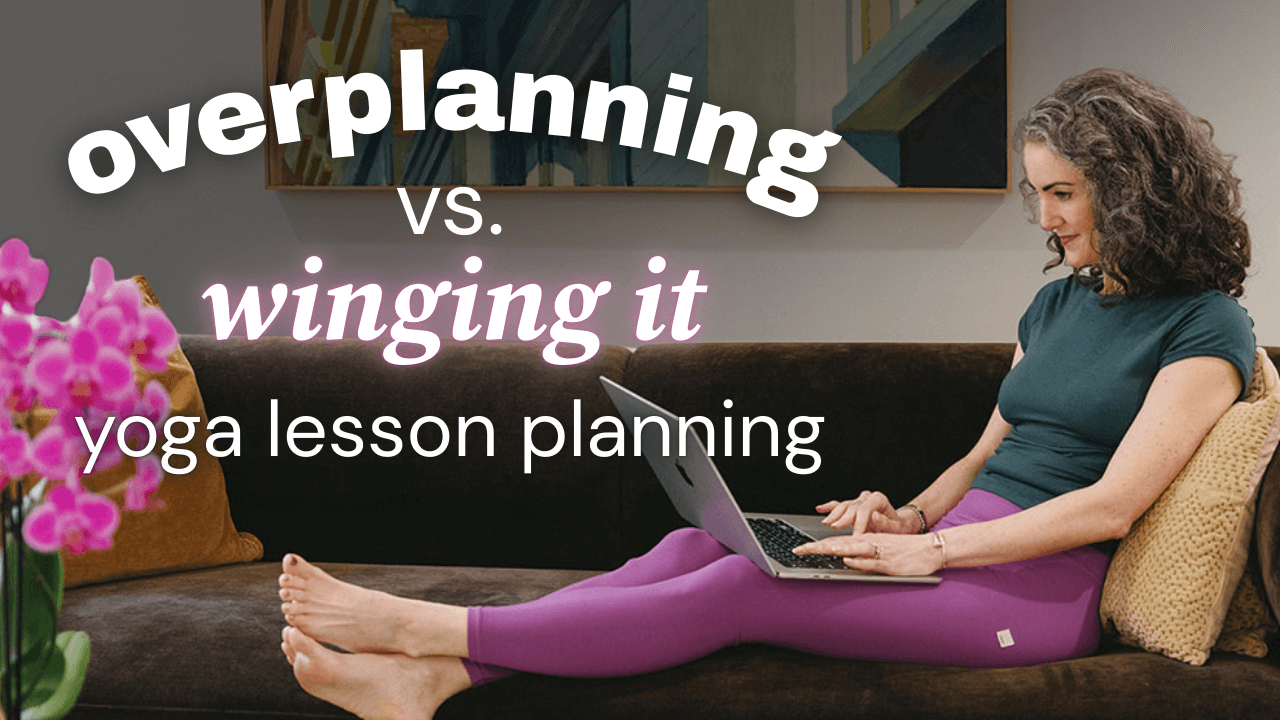
For the first few years I was teaching yoga, I swung like a pendulum between two exhausting extremes.
Some weeks I’d spend three hours planning a single sixty-minute class—color-coded notes, backup sequences, contingency plans for every possible student who might walk through the door. I’d research transitions, sketch out timing for each pose, and write out my cues word for word. Then I’d lie awake the night before, mentally rehearsing the whole thing.
Other weeks? I’d show up with nothing but vibes and a vague idea that we’d “flow and see what happens.” I’d tell myself I was being “intuitive” or “responsive to the room.” But honestly? I was just burned out from the week before.
Neither one felt good. And neither one served my students the way I wanted.
If this sounds familiar, you’re not alone. Most yoga teachers I work with are stuck bouncing between these extremes—and there’s a name for it.
What Is the Planning-Confidence Cycle?
The Planning-Confidence Cycle is the trap that keeps yoga teachers bouncing between overplanning and winging it. It starts with doubt.
You doubt your ability to plan an effective class. Maybe you just finished your 200-hour training and you’re not sure you learned enough about sequencing. Maybe you’ve been teaching for years but you still feel like you’re faking it. Maybe you had a class recently that fell flat and now you’re second-guessing everything.
That doubt leads you to do one of two things.
Option one: you overcompensate. You spend hours researching, scrolling Instagram for sequence ideas, stitching together bits and pieces from different teachers, trying to create the “perfect” class. By the time you’re done, you’ve invested three or four hours into a sixty-minute class—and you haven’t even taught it yet.
Option two: you avoid. Planning feels overwhelming, so you just don’t. You tell yourself you’ll figure it out when you get there. You’ll read the room. You’ll be spontaneous.
Here’s the thing: either way, this affects how confidently you teach.
When you overplan, you’re too in your head during class. You’re so attached to the sequence you mapped out that you can’t actually see the students in front of you. Someone’s struggling and you don’t notice because you’re mentally rehearsing the next transition. You’re teaching to your notes, not to your students.
When you underplan, you’re uncertain whether what you’re offering is balanced or effective. You might forget to include twists. You might realize halfway through that you’ve been in standing poses for twenty-five minutes. You feel scattered—and your students feel it too.
And here’s the kicker: the lack of confidence you feel during teaching feeds right back into your planning anxiety for the next class. The cycle continues.
What Yoga Philosophy Teaches Us About Balance
This isn’t a new problem. The tension between structure and freedom, between effort and ease—the ancient yoga teachers understood this deeply. And they gave us language for navigating it.
Sthira and Sukha
In Patanjali’s Yoga Sutras, we find the phrase sthira sukham asanam—the seat should be steady and comfortable. Sthira is stability, steadiness, effort, structure. Sukha is ease, comfort, softness, freedom.
Every pose should have both. Not all effort. Not all ease. Both, held in balance.
Think about warrior two. You need the strength and stability of sthira to hold the pose—the engaged legs, the lifted arms, the steady gaze. But you also need the ease of sukha—the softness in your face, the relaxed shoulders, the breath that flows freely. Too much sthira and you’re rigid. Too much sukha and you collapse.
This same principle applies to your planning.
The overplanner has too much sthira. There’s so much structure, so much effort, so much rigidity that there’s no room for responsiveness. The teacher feels exhausted before they even begin. And ironically, all that planning creates more anxiety—because now there’s more to remember, more that could go wrong.
The teacher who wings it has too much sukha. There’s so much freedom, so much “going with the flow” that there’s no grounding. The class feels scattered. The teacher feels unmoored.
The answer isn’t to swing from one extreme to the other. The answer is the middle path—where structure creates freedom, where preparation enables responsiveness.
Abhyasa and Vairagya
There’s another pair of Sanskrit terms that illuminates this beautifully: abhyasa and vairagya.
Abhyasa means consistent, dedicated practice—showing up, again and again, doing the work. In teaching terms, this is your dedication to having a plan, to preparing thoughtfully for your students, to knowing your sequences well.
Vairagya means nonattachment—releasing your grip on specific outcomes. In teaching terms, this is your willingness to set the plan aside when the room needs something different. It’s teaching to the students who actually showed up, not the students you imagined when you were planning.
You do the work of planning. You know your sequence. You’ve practiced it in your own body. That’s abhyasa.
And then you walk into the room, see who’s actually there, and release your grip on the plan so you can be present with your students. That’s vairagya.
This is where confidence lives—not in perfect preparation, but in the balance between showing up prepared and letting go of attachment to how it unfolds.
How to Break the Planning-Confidence Cycle
So how do you actually find this middle path? Here are practical steps.
Recognize Which Extreme You Tend Toward
Be honest with yourself. Are you spending more time planning classes than teaching them? Do you have notebooks full of sequences you’ve never actually used? That’s too much sthira—you need more ease, more trust, more willingness to let go.
Or are you chronically underprepared? Do you avoid planning because it feels overwhelming? Do you tell yourself you’re being “intuitive” when really you’re being avoidant? That’s too much sukha—you need more structure, more grounding.
Knowing your tendency is the first step to finding balance.
Embrace Repetition
This might be the most counterintuitive advice I give: I teach the same lesson plan for an entire month.
Not because I’m lazy. Because repetition serves my students.
When my students practice the same sequence week after week, they build body memory. They build confidence. They stop having to think so hard about what comes next, and they can drop into their bodies.
And here’s what repetition does for me as a teacher: it frees me up to actually teach. When I know my sequence so well I could teach it in my sleep, I’m not in my head trying to remember what comes next. I’m watching my students. I can read the room and respond—not because I’m winging it, but because my preparation has created the space for responsiveness.
Develop a Framework You Trust
One of the biggest sources of planning anxiety is the fear that you might leave something out. What if the class isn’t balanced? What if you forget twists?
A good framework eliminates that anxiety.
The 6-4-2 framework I teach—six moves of the spine, four lines of the legs, two core actions—gives me confidence that every class is balanced, no matter what. I don’t have to overthink it. The framework has my back.
When you trust your framework, planning becomes faster. You’re not starting from scratch every time. You have a structure that works, and you simply fill it in.
Experience Your Sequence Before You Teach It
This is part of my S.E.R.V.E. Method—the E stands for Experience. Don’t just plan your sequence on paper. Practice it in your own body.
When you’ve actually moved through the sequence, you know where the transitions feel awkward. You know which cues make sense. You know how long things actually take—not how long you imagine they’ll take.
This is preparation that builds genuine confidence—the real confidence of having felt it in your body.
Finding Your Middle Path
The Planning-Confidence Cycle isn’t a character flaw. It’s not a sign that you’re not cut out for teaching. It’s simply what happens when we haven’t found our balance yet—when we’re oscillating between too much structure and too much freedom.
The ancient teachers knew this tension. They lived it, just like we do. And they gave us frameworks for finding the middle path.
Sthira and sukha. Steadiness and ease.
Abhyasa and vairagya. Showing up prepared and releasing attachment to how it unfolds.
This is where confident teaching lives. Not in perfect preparation—because perfection doesn’t exist. Not in winging it—because that’s not actually freedom. Confidence lives in the balance.
You already have what you need to be a good yoga teacher. The frameworks exist. The support exists. You just need to find your balance.
Want to go deeper? Listen to the full episode of Yoga Teacher Confidential: The Planning-Confidence Cycle.

