Your training barely covered yoga nidra. Here’s everything you need to know—and the five-step recipe that makes it teachable.
Most yoga teachers got about fifteen minutes of yoga nidra training. Someone read a script, you laid there, and now you’re expected to teach it. If that sounds familiar, you’re not alone—and you’re in the right place.
I’m Sage Rountree. I’ve been teaching yoga for over twenty years, I’ve guided hundreds of nidra sessions, and I created a course called Teaching Yoga Nidra that gives teachers a practical, repeatable method for guiding deep rest.
In this post, I’m covering two big questions: What is yoga nidra, really? And how do you actually teach it? I also made two videos that walk through each topic in depth—I’ll link them below so you can watch and listen at your own pace.
And because I want you to try this right away, I made a free five-minute yoga nidra script you can use with your students tonight. Grab it here:
What Is Yoga Nidra? (A Clear Explanation for Yoga Teachers)
Watch the full video:
If a student asked you right now, “What is yoga nidra?”—could you explain it in one sentence without using the word “sleep”? Most yoga teachers can’t. Let’s fix that.
What yoga nidra is not
Yoga nidra is not sleep. The name translates to “yogic sleep,” and that’s where the confusion starts. Your students are not sleeping. They’re lying down, eyes closed, fully supported—but they’re awake. Hovering in that threshold between waking and sleeping, where the body rests deeply but awareness stays present.
Yoga nidra is not meditation. Meditation typically asks you to do something with your attention—focus on the breath, observe your thoughts, return to a mantra. Yoga nidra is more receptive than that. Your students follow your voice. You’re guiding them. They’re not efforting their way through it.
Yoga nidra is not hypnosis. Nobody is being put under. There’s no suggestion loop, no loss of agency. Your students can open their eyes and leave at any time. They’re choosing to rest.
And yoga nidra is not just a long savasana. Savasana is stillness. Yoga nidra is a guided journey through layers of experience. There’s a structure. There’s a direction. That structure is what makes it teachable.
So what is yoga nidra?
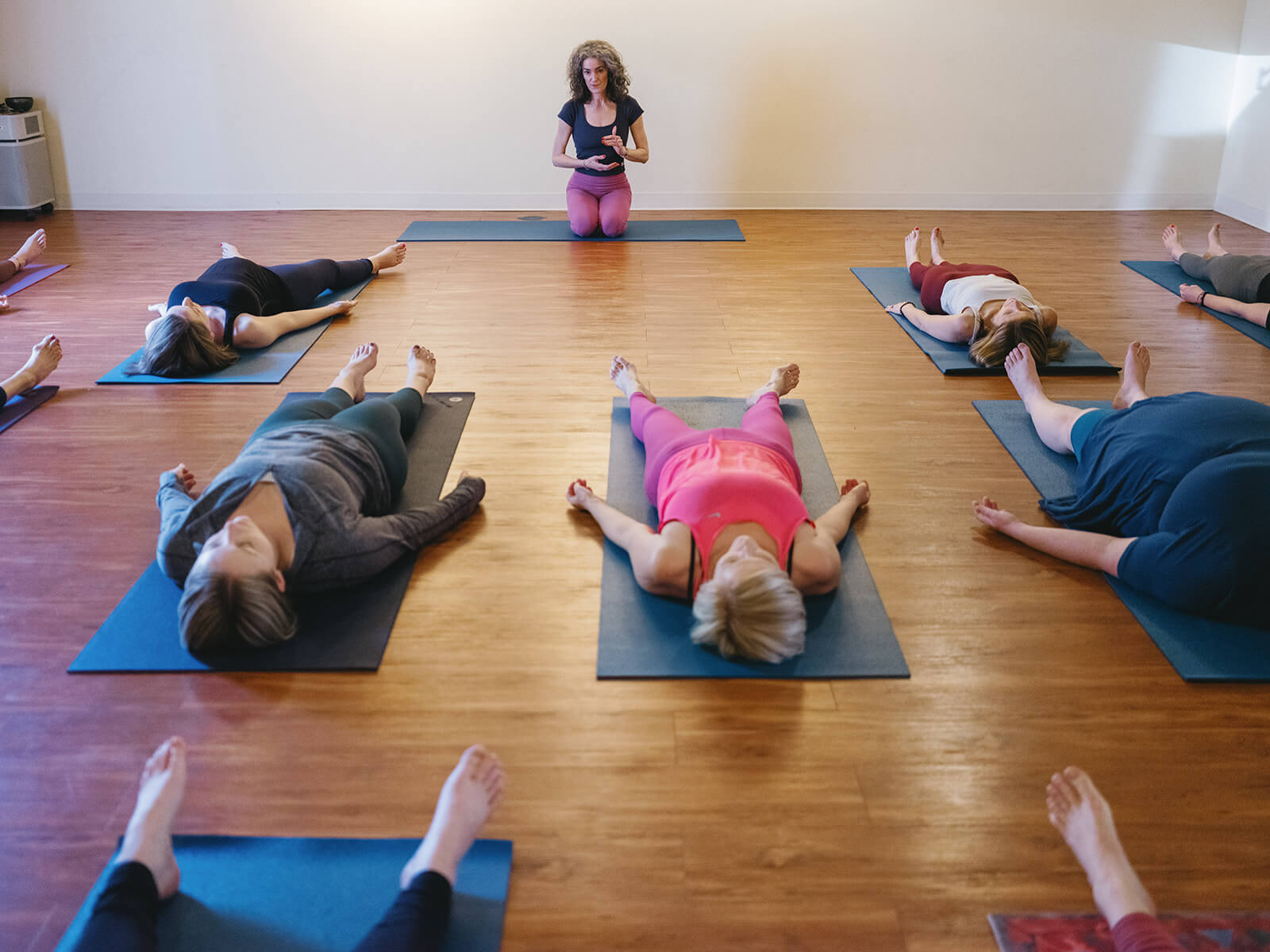
Yoga nidra is a guided rest practice. Your students lie down in a comfortable position—usually savasana with bolsters, blankets, an eye pillow—and you guide their awareness through a series of layers. Body sensations. Breath. Emotions and opposites. Visualization. And finally, a deep, open stillness.
Those layers come from the koshas—a framework from yoga philosophy that describes five sheaths of human experience, from the physical body all the way to your innermost sense of peace. You don’t need to teach the koshas to your students. But as a teacher, knowing they’re there gives you the map.
Your one-sentence definition
Here’s the version you can use with anyone:
Yoga nidra is a guided rest practice where I lead you through layers of awareness—body, breath, mind, intuition, and peace—so you can access deep rest without falling asleep.
It’s a clear description of what your students will experience.
Why getting this explanation right matters
Your students will trust you more. When you can explain what you’re about to guide them through—clearly and calmly—they relax before you even start. Uncertainty creates tension. Clarity creates safety.
You can pitch it. If you want to offer a yoga nidra class, a workshop, or a series at your studio, you need to describe it to someone who’s never heard of it. “It’s like yogic sleep” is not a pitch. “I guide you through layers of awareness so you can access deep rest without sleeping” is a pitch.
You stop second-guessing yourself. Once you have a clear definition and a clear structure, the hesitation disappears. You know what it is. You know how to explain it. Now you just need a recipe for guiding it.
Phrases you can borrow right now
Before a nidra session:
“We’re going to do a guided rest practice called yoga nidra. You’ll lie down, get really comfortable, and I’ll guide you through a series of steps—body awareness, breathing, some visualization. Your only job is to listen and rest. If you fall asleep, that’s fine. If you stay awake, that’s great. Either way, you’ll feel the benefits.”
If someone asks what makes it different from meditation:
“In meditation, you’re usually directing your own attention. In yoga nidra, you follow my voice. I do the navigating. You just rest.”
If a studio owner asks why they should add it to the schedule:
“Students are burned out and overstimulated. Yoga nidra gives them permission to rest—with structure. It’s one of the most requested offerings right now, and it doesn’t require any physical ability. Anyone can do it.”
How to Teach Yoga Nidra (Even If Your Training Barely Covered It)
Watch the full video:
Now that you know what yoga nidra is, let’s talk about how to teach it. The problem most yoga teachers face isn’t motivation—it’s method. Nobody gave you a framework. Let’s change that.
Teaching yoga nidra is more like cooking than performing
If someone handed you a pile of spices, some protein, and a burner and said “make dinner”—you’d probably freeze up or wing it. But hand that same person a recipe that says “do this, then this, then this”—and you’ll cook a solid meal. After you’ve made it ten times, you’ll start improvising with confidence.
Yoga nidra has a recipe. Once you learn the five steps, you’ll never have to guess again.
The five-step recipe: Body. Breath. Brain. Belly. Bliss.
The recipe is built on the koshas—the layers of your being described in yoga philosophy. But you don’t need to memorize Sanskrit to use this. I’ve boiled it down to five words, all starting with B:
- Body. You start with the physical. Guide your students’ awareness through the body systematically so they land in the present moment.
- Breath. Narrow the focus from the whole body to a single rhythm. The breath becomes the bridge between the outer and inner layers.
- Brain. This is the layer of thoughts, emotions, and opposites—where you help students observe their inner landscape without getting stuck in it.
- Belly. Beneath the thinking mind is a quieter knowing. You access it through visualization and imagery.
- Bliss. The innermost layer. You don’t create it. You create the conditions for your students to find it.
Then you reverse the journey—bliss back to body—and guide them gently into the room.
That’s it. Five steps, always in the same order, scalable to any length. Five minutes tucked into savasana. Forty-five minutes as a standalone class. Ninety minutes as a workshop. Same recipe, different portions.
The question most teachers have at this point is: But what do I actually say? That’s exactly what the free script is for.
It follows this exact recipe, step by step, with the specific language and pacing you need. Read it to your students tonight and you’ll feel the framework click into place.
Your students need rest. Now you have a recipe.
You know what yoga nidra is. You know it’s not sleep, not meditation, not hypnosis, and not just a long savasana. You have a clear, one-sentence definition you can use with anyone. And you have the five-step recipe—body, breath, brain, belly, bliss—for guiding nidra sessions of any length.
The next step is simple: try it.
Download the free five-minute yoga nidra script and read it to your students this week. It follows the exact recipe you just learned. You already have everything you need: the recipe and your own voice. Pop your email here and I’ll send it right to you:
And if you want the complete system—the full Master Recipe with annotations, model scripts to study and adapt, fifteen video lectures, a custom GPT for building your own sessions, and twenty Yoga Alliance continuing education units—check out my course, Teaching Yoga Nidra. It’s self-paced, practical, and designed for yoga teachers with full schedules.
Your students are waiting for someone to guide them into rest. Why not you?