
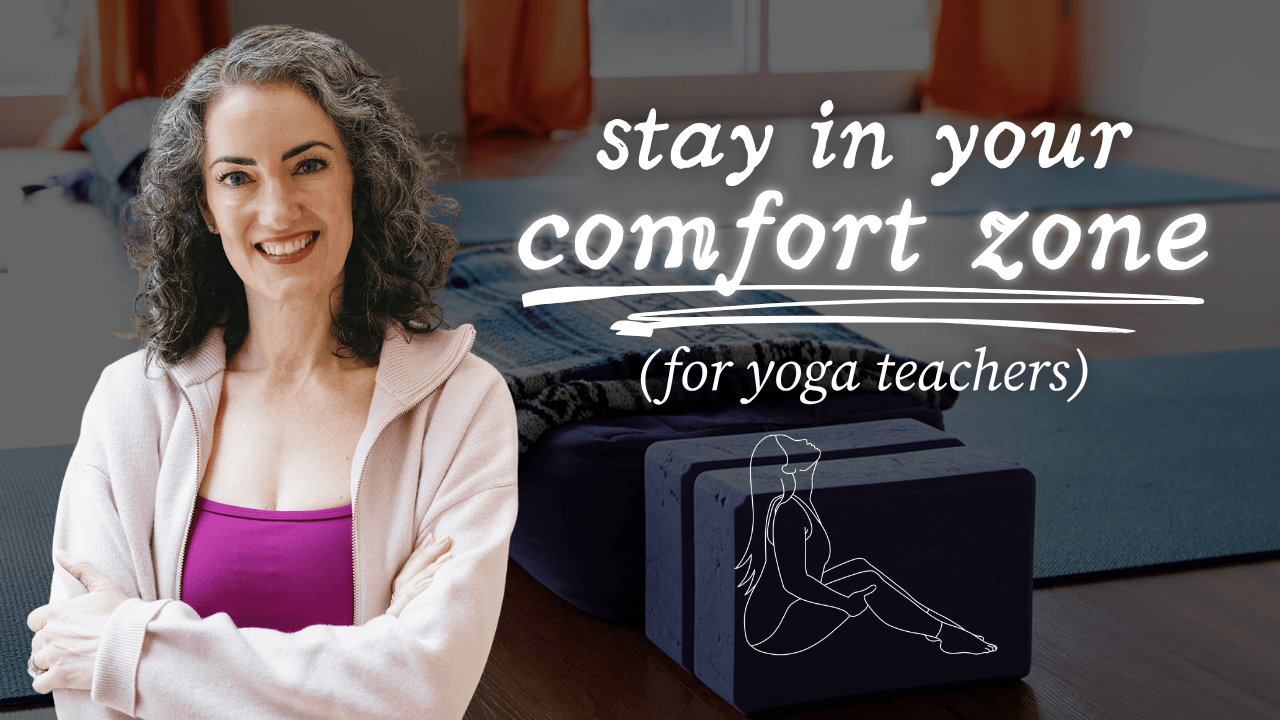
“Get out of your comfort zone.” It’s everywhere—bumper stickers, Instagram captions, motivational posters. The message is clear: your comfort zone is a problem to be solved.
But here’s a definition I keep coming back to: the place where you can operate without fear of failure. Read that slowly. Being in your comfort zone isn’t a limitation. It’s a superpower. And as a yoga teacher, your work isn’t to escape it—it’s to expand it until teaching whoever walks through your door lives inside it.
That’s why I named my virtual studio Comfort Zone Yoga®. In Episode 80 of Yoga Teacher Confidential, I share what that actually means—for your teaching, your confidence, and the students who trust you with their practice.
The Room Doesn’t Lie
Think about what happens right before you teach. Someone unfamiliar walks in—a first-timer, someone in a bigger body, someone who looks like they could teach your class. Something tightens. You second-guess your plan. You’re in your head instead of in the room.
That tightness is the edge of your comfort zone. Most teacher trainings never give you the tools to work with it. You learn anatomy you’ll rarely use. You practice on fellow trainees who already love yoga. Then you graduate into a room full of real humans who look nothing like the people you trained with.
The answer isn’t more credentials. It’s better structure—the kind that gives you a reliable foundation for class planning so your mind is free to actually see who’s in front of you.
Your Backstory Is Your Curriculum
One of the ideas I return to again and again—and lay out in The Professional Yoga Teacher’s Handbook—is this: the obstacle you overcame gives you the authority to teach the students who share that challenge.
You couldn’t touch your toes for years? You know exactly where people get stuck. You rebuilt after an injury? You understand what it feels like to be scared of trying again. You came to yoga from a bigger body? You know every step of that path from the inside.
The person who struggled with balance teaches balance better than the person who never wobbled. This is what real teaching confidence looks like—not more certifications, but the earned wisdom of having been there yourself.
Two Sides of Comfort
The name Comfort Zone Yoga holds two ideas at once.
Most students come to yoga to get comfortable with discomfort—learning to breathe through difficulty, to stay when the body wants to bail. That’s real and valuable work.
But the populations I work with most—especially athletes—already know how to push. They live at the edge of their growth zone every single day. For them, the harder practice is learning to be comfortable with comfort: the stillness, the rest, the recovery. Yin yoga. Restorative yoga. Yoga nidra. These are the practices that hold the most rewards for people who already know how to push—and they’re the hardest for those people to access.
As a teacher, your job is to know the difference. Read the room. Meet people where they actually are.
The Frameworks That Make It Possible
Expanding your comfort zone isn’t about white-knuckling your way through terrifying situations. It’s about building systems reliable enough that your mind is free to be present.
The two I’ve built my entire teaching life on are the 6–4–2 Framework and the S.E.R.V.E. Method.
The 6–4–2 Framework is a checklist for balanced movement: six moves of the spine, four lines of the legs, two core actions—stabilization and articulation. It’s not a formula for counting poses. It’s a structural checklist that eliminates guesswork so you can build a physiologically balanced class for whoever shows up.
The S.E.R.V.E. Method is the bigger system: Structure your sequences using 6–4–2. Experience your sequence as a student before you teach it. Repeat your lesson plan for a month with intentional weekly variations. Vary with intention based on who’s actually in front of you. Evolve your voice over time.
When you have these tools, you’re not staring at a blank page on Sunday night. The anxiety quiets. What replaces it is real confidence—the kind that comes from knowing your structure is sound and your only job is to be present. For a deeper look at why your students actually want repetition, that’s worth a read alongside this episode.
The Teacher Is Not the Center
Here’s the paradox I want you to sit with. The fears that feel the biggest for yoga teachers—imposter syndrome, self-doubt, “what if they find out I don’t know enough?”—all have one thing in common: they put the teacher at the center.
But the teacher isn’t the center. The teacher is the guide.
When you shift that center back to the practice and the students, those fears start to quiet. You become almost everyone’s favorite yoga teacher not by trying to be everyone’s favorite—but by genuinely pouring your energy into helping the people in front of you.
Ironically, that’s what makes them love you.
Experience It for Yourself
If this resonates, I’d love for you to join me at a free live open house—April 18 or May 16, both at noon Eastern—where you can experience what learning together at Comfort Zone Yoga actually feels like.
Or start with Finding Your Voice—a free mini-course inside Comfort Zone Yoga—or pick up The Professional Yoga Teacher’s Handbook. By the time you finish either one, you’ll know whether this is your world.

