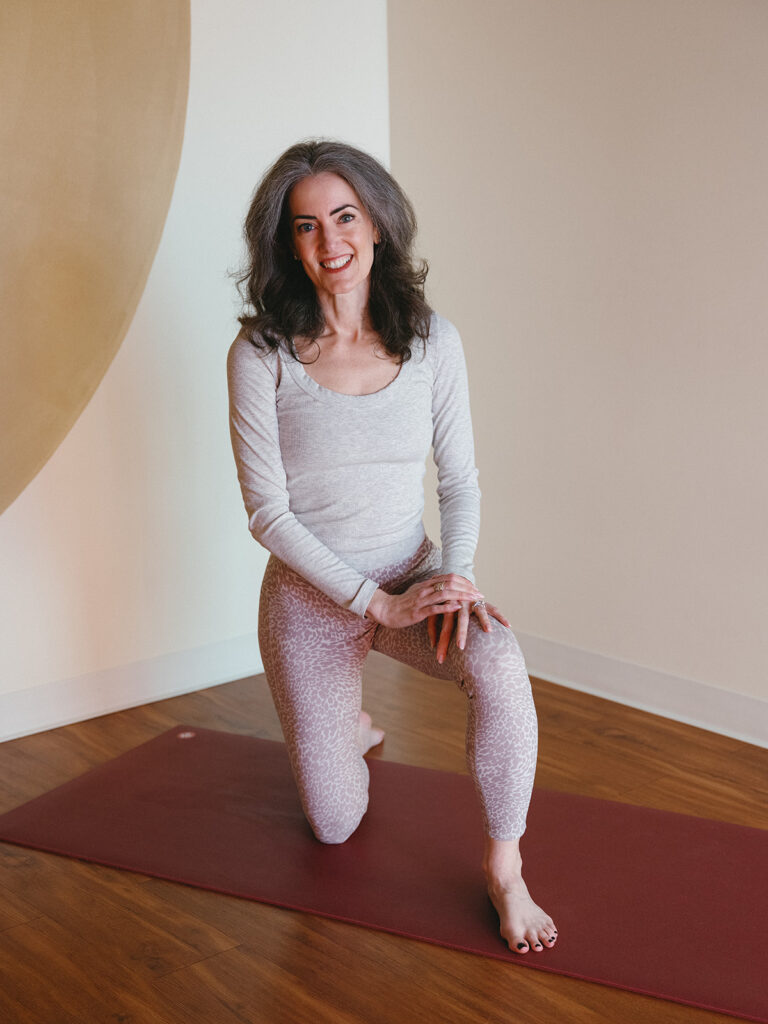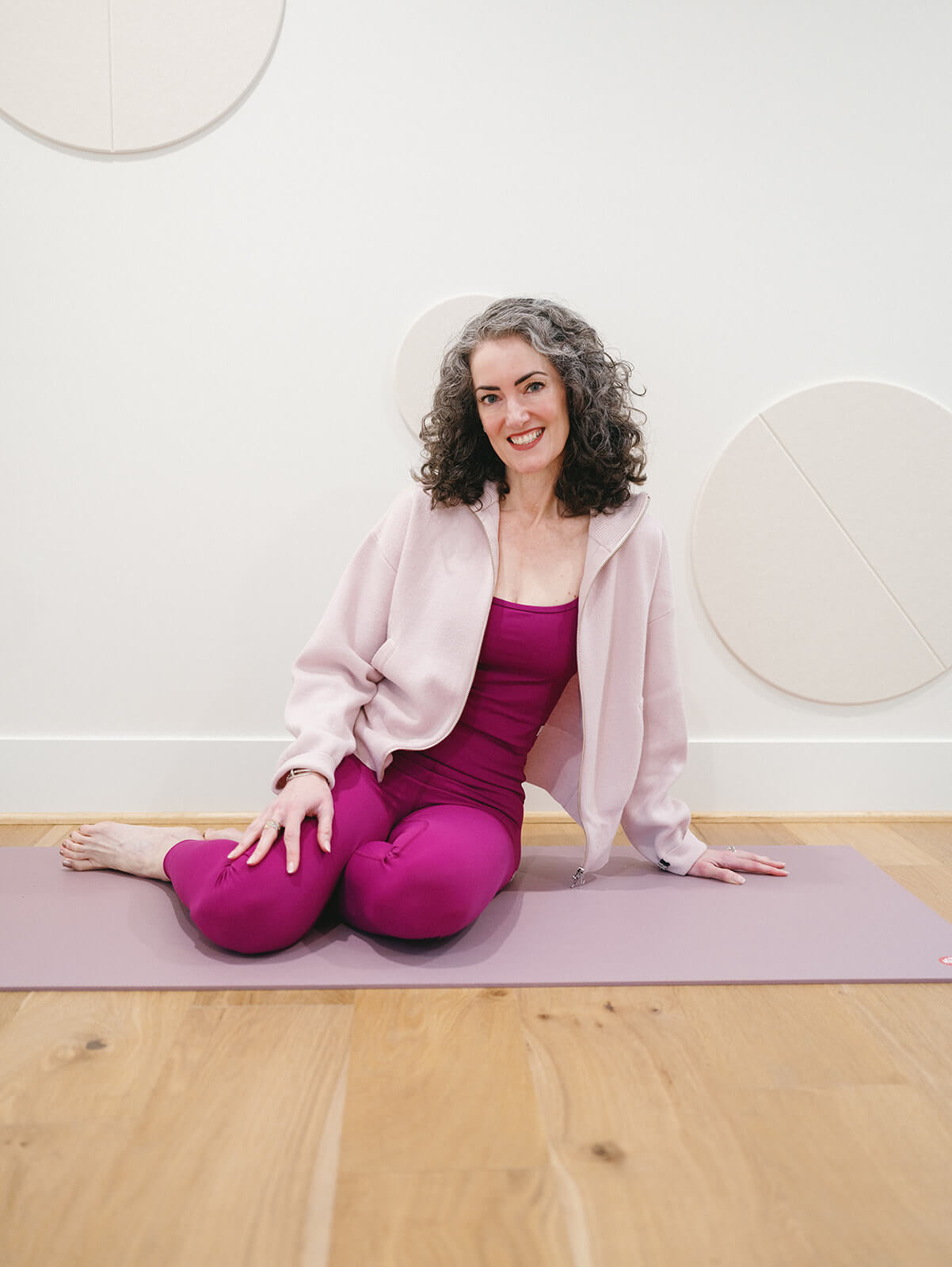
Lana Boone remembers the feeling well: standing at the front of the room, trying to teach something other than her familiar Baptiste sequence, and feeling absolutely terrified.
“Before your program, I was terrified to teach them,” she told me recently, referring to the variety of class formats she’s now known for. “All I had was Baptiste in my back pocket.”
Today, Lana is the lead teacher at Yoga Six in Potomac, Maryland. She teaches power, slow flow, mobility, restorative, and sound bath—all confidently. Her classes are filling up. And lesson planning? It takes her fifteen minutes instead of hours.
What changed? A framework-based approach to sequencing that gave her the structure she needed to feel confident teaching anything.
The Problem With Set Sequences
Lana came to yoga through an unusual path. With fifteen years of dance background, she first discovered yoga through Kundalini—drawn to its energetic approach rather than physical postures. It wasn’t until the pandemic, when she was recovering from illness and turned to sun salutations on Peloton with Dr. Chelsea Jackson Roberts, that something clicked.
She got her 200-hour certification and started teaching. But like many new teachers, she relied heavily on set sequences—specifically, a modified Baptiste flow that became her comfort zone.
“I was so stuck in a groove that even if I did make a plan of how I wanted to change the class, I would just quickly forget it and just keep doing what I’ve always done,” Lana explained.
This is a common trap. Set sequences feel safe because they’re memorized. But they also become limiting. Teachers get stuck teaching the same thing over and over, not because it serves their students best, but because they don’t know how to confidently create something new.
The Chunking Breakthrough
What shifted for Lana was learning to think about sequences in chunks rather than pose-by-pose memorization.
“Just thinking about it in chunks and also thinking about trying to incorporate the 6-4-2 method in your chunk,” she said. “And that applies across all formats.”
The 6-4-2 framework gives teachers a simple checklist: six spinal movements, four positions, two categories of strength and flexibility. Instead of memorizing dozens of poses in a specific order, teachers learn to balance a warm-up chunk, a standing chunk, a floor chunk, and a finishing chunk—each following the same principles.
“When I sequence in this way, it’s so much easier to remember,” Lana shared. “When I’ve got a set sequence I have to learn, sometimes that takes me so much longer than when I’m thinking about it in chunks.”
This is the difference between following a recipe and understanding cooking principles. Once you know the principles, you can create endless variations without starting from scratch each time.
Beyond the “Peak Pose” Approach
Lana also found freedom in stepping away from traditional peak pose sequencing—an approach that never resonated with her in the first place.
“I was never a big peak pose type of person,” she explained. “I didn’t look at yoga in that way. I didn’t come to yoga for that. I’m not trying to contort my body in some type of crazy shape . . . I’m coming to flow and move through energy.”
With her dance background and initial draw to Kundalini, Lana was always more interested in how students feel at the end of class than what impressive pose they might “achieve.” The 6-4-2 framework gave her permission to sequence for experience rather than destination.
“Being able to sequence in a way that just wasn’t peak and instead chunk it so that people just feel like they’ve had a really great class—they’ve really wrung some things out, perhaps in their system that they needed to ring out, or maybe they just feel their nervous system has completely relaxed.”
What Students Actually Want
Here’s the interesting thing: when Lana started teaching the same sequence for a full month—varying it slightly but keeping the core structure consistent—her students loved it.
“They love the idea that they could master something new every month,” she said about her studio students. “And I was very open about what we were learning. And they’ve been on the ride with me.”
Some of her longer-term students at other venues initially said they were “bored” with repetition. But when Lana tried giving them something different, they realized what they actually valued.
“They realized, no, we love the meditative aspect of doing basically the same thing over and over and over again,” Lana said. “They realized that there was a value in repetition.”
This tracks with what I’ve seen over twenty years of teaching: students often think they want novelty, but they actually crave the depth that comes from practicing the same sequence long enough to stop thinking about what comes next.
The Biomechanics Complement
Lana also credits Jenni Rawlings’s biomechanics work for completing her confidence transformation. Where sequencing frameworks give you the “what” and “why” of class structure, biomechanics gives you the “why” behind alignment cues.
“I had so much fear around injuring students because of what I had been told,” Lana shared. “And to learn that, actually, it’s really hard for people to sincerely injure themselves in such a low impact and slower practice like yoga.”
The combination gave her something she’d never had before: the ability to answer student questions confidently.
“I have students coming up to me all the time asking me about alignment positions, asking me about a pain here or a pain there,” she said. “And now I can say: what is your goal for this particular posture?”
One moment stands out: an older student with arthritis in her hands had been asking every teacher in the studio about modifying down dog. No one could help her—until Lana.
“She walks out the room, out the studio, declares to the entire lobby: Lana is the only one who understands biomechanics in this place. She is the only one.”
The Business of Teaching
What strikes me most about Lana’s story is how her previous business experience prepared her to approach teaching professionally. She understands boundaries, negotiation, and the value of making students feel seen.
“It’s really connecting with the customer—or in this case, the student,” she said. When she started truly looking students in the eye and connecting with them in class, everything shifted. “Not only did I start having more fun, I think my students also really started having more fun.”
She also understands something many teachers struggle to accept: if you’re not getting what you’re worth, resentment builds. “I’d rather have a conversation and say, hey, this is what I teach at. Is it possible to meet this?”
That confidence—in sequencing, in alignment, in business—led directly to her recent announcement as lead teacher at Yoga Six.
What This Means for You
If you’re stuck in a teaching rut, terrified to branch out into new formats, or spending hours on lesson planning, Lana’s story offers a clear path forward: frameworks.
Not rigid rules that constrain your creativity, but principles that give you confidence to teach anything. When you understand the why behind balanced sequencing, you can create endless variations without starting from scratch each time.
“It all goes back to that lesson planning and actually teaching people yoga in this way,” Lana reflected. “I was so scared of being a physicality-based teacher because, again, for me, the practice has always been about energetics. But now I don’t have that fear. I can teach the physicality well. I feel comfortable teaching the physicality. And then I can also add energetics here and there too.”
That’s the goal: not to replace your unique voice with formulas, but to give you the structure that lets your voice shine through.
Want to hear Lana’s full story? Listen to episode 64 of Yoga Teacher Confidential!