
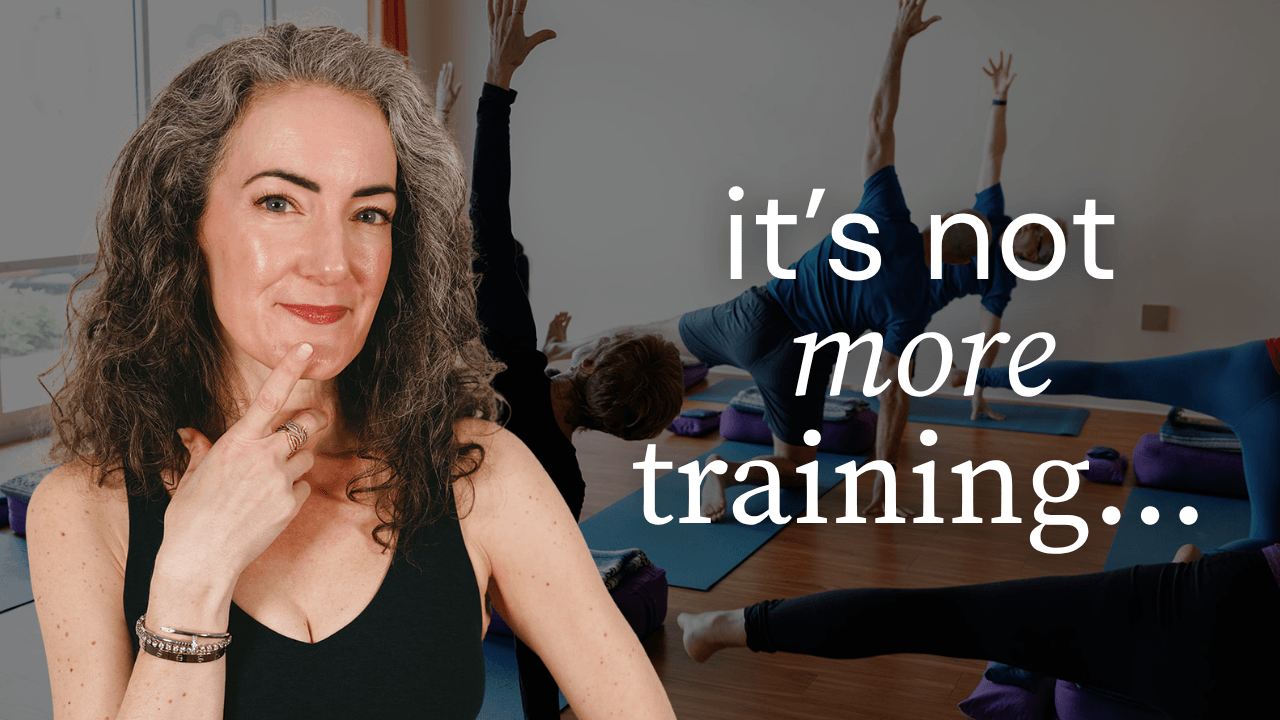
Most new yoga teachers think confidence comes from more training. Twenty years in, I can tell you—it doesn’t.
I’ve trained hundreds of teachers in my programs at Carolina Yoga Company and Comfort Zone Yoga®, and I’ve watched the same confidence crisis show up again and again: in brand-new teachers, in experienced teachers returning after a break, and in teachers who’ve stacked certification on top of certification and still feel like they’re not ready.
In this post, I’ll show you where confidence actually comes from, the five phases every yoga teacher moves through on the path to mastery, and five practical tools you can put to work in your very next class.
My YouTube channel offers tons of Sage advice for your first year—and beyond—as a yoga teacher:
You Are Not the Hero of Your Yoga Class
Here’s the key that took me years to fully absorb: your students are the heroes of your class. You’re the guide.
That sounds simple, but it changes everything about how you show up at the front of the room. When you cast yourself as the performer—the expert, the one who has to impress—you carry the entire weight of the class on your shoulders. Every blank expression feels like judgment. Every student who leaves early feels like a verdict. Every moment you fumble a cue feels like proof you don’t belong up there.
When you understand that your job is to guide—Obi-Wan to your students’ Luke Skywalker, the stage manager while they’re the actors—that pressure dissolves. You’re not there to be impressive. You’re there to serve.
This reframe doesn’t just reduce anxiety; it makes you a better teacher. The moment you stop performing for your students and start paying attention to them, you can make real-time adjustments based on what they actually need. That responsiveness is what experienced teachers have and what newer teachers are working toward. It begins with the mindset shift that takes the pressure off and lets you actually teach.
Confidence Comes from Reps, Not Certifications
I hear some version of this every week: “I just need to finish my 300-hour training, and then I’ll feel ready.” Or “Once I get my Yin certification, I’ll feel more confident.”
I understand the impulse. More training feels like more permission.
But twenty years of teaching has taught me that confidence is not deposited by certifications. It’s built through reps.
Think of it like cooking. A chef doesn’t get confident by memorizing every recipe in the book. They get confident by cooking the same dish dozens of times until their hands know what to do before their brain catches up. The recipe gave them a starting point. The reps gave them confidence.
Teaching yoga works the same way. Your training gave you the framework. The classes build the confidence. If you’re tempted to stack another credential before stepping back into the room, please read why more yoga certifications won’t make you a better teacher first.
One more thing worth saying out loud: the students in your class this week are not waiting for you to have more letters after your name. They signed up to practice yoga. They want to feel good in their bodies and find a moment of calm in a complicated week. You already have what they need.
The Yoga Teacher Success Timeline: 5 Phases Every Teacher Moves Through
One of the most useful frameworks I’ve developed over the years is what I call the Yoga Teacher Success Timeline. Most yoga teachers move through five phases over the course of their careers, and knowing which phase you’re in is enormously helpful—it normalizes whatever you’re struggling with right now.
Phase 1: Post-Training Panic
You have your certificate. You’ve done the hours. And you feel completely unprepared. This is normal. This is nearly universal. The certificate is not a guarantee of competence—it’s an invitation to go develop it.
Phase 2: Finding Your Footing
You start getting regular classes. You develop a handful of sequences you trust. You learn your students’ names. The blank faces stop terrifying you.
Phase 3: Building Momentum
You find your niche. You develop a signature style. You start thinking beyond the class in front of you to your teaching career as a whole.
Phase 4: Thriving
You have healthy boundaries, referral networks, and loyal students. You’re not just surviving the teaching week—you’re actually enjoying it.
Phase 5: Mastery and Legacy
You’re training the teachers who will train the teachers. Your impact multiplies beyond what you can personally deliver.
The teachers you admire—the ones who seem so settled, so at ease at the front of the room—they all went through Phase 1, too. Post-Training Panic is not a sign that you’re not cut out for this. It’s just Phase 1. Keep going.
5 Practical Tools You Can Use This Week
1. Learn your students’ names.
This one is low-tech and high-impact. When you greet someone by name, you’re telling them: you are seen, you belong here, I’m glad you came. Connection builds confidence on both sides of the mat—theirs and yours.
2. Use a consistent sequence.
I know this can feel counterintuitive—shouldn’t you keep it fresh? Here’s the truth: your students learn through repetition. Their bodies need to practice the same movements multiple times to absorb them. When you teach a sequence you know deeply, you can pay attention to your students instead of scanning your mental outline for what comes next. Consistency isn’t stagnation; it’s the foundation that makes presence possible. For the prep framework that makes this almost automatic, see the S.E.R.V.E. method and 6-4-2 framework.
3. Start and end with intention.
The opening and closing of your class are what your students will remember. A grounded, specific opening tells them what they came for. A memorable closing sends them out with something to carry. These don’t need to be elaborate—a single clear sentence will do more work than five vague ones. If you want to get more deliberate about your first two minutes, I have a whole post on how to start your yoga class with confidence.
4. Step off your mat.
Your mat is not a raft protecting you from the sea of students. When you walk the room and get close to the people in front of you, you become more attuned, your students feel more seen, and your teaching becomes a real conversation instead of a performance. As a bonus, you stop fixating on your own delivery and start noticing what your class actually needs. A simple way to support this is the 3-Cue Rule—when you trust your cues, you can finally look up.
5. Reframe your nerves.
Nerves are not the enemy. Nerves mean you care about your students’ experience. I’ve been teaching for more than two decades, and I still feel a flutter before a class I’m invested in. The day that flutter disappears might be the day I’ve stopped caring enough to be fully present. So instead of trying to eliminate nerves, translate them: that tightness in your chest isn’t dread—it’s readiness.
The Long Game
Confidence isn’t a destination that you’ll finally arrive at; it’s an ongoing practice. And like yoga itself, it isn’t linear. You’ll have classes where everything flows and you feel like the best teacher you’ve ever been. You’ll have classes where nothing lands and you leave wondering why you do this at all.
Both of those classes are making you better. The wins give you evidence that you can do this. The hard classes give you the friction that builds real skill. The teachers who develop durable, lasting confidence are not the ones who had the smoothest start; they’re the ones who kept showing up, especially after the hard classes.
So, which phase of the Yoga Teacher Success Timeline matches where you are right now—Post-Training Panic, Finding Your Footing, Building Momentum, Thriving, or Mastery and Legacy? Leave a comment and tell me. I read every single one.
Want to keep working on this alongside a community of teachers who get it? Join The Zone, my free community for yoga teachers, at comfortzoneyoga.com. You’ll get monthly live calls, lesson plan templates, and access to 3,400+ teachers building their confidence right alongside you.

