
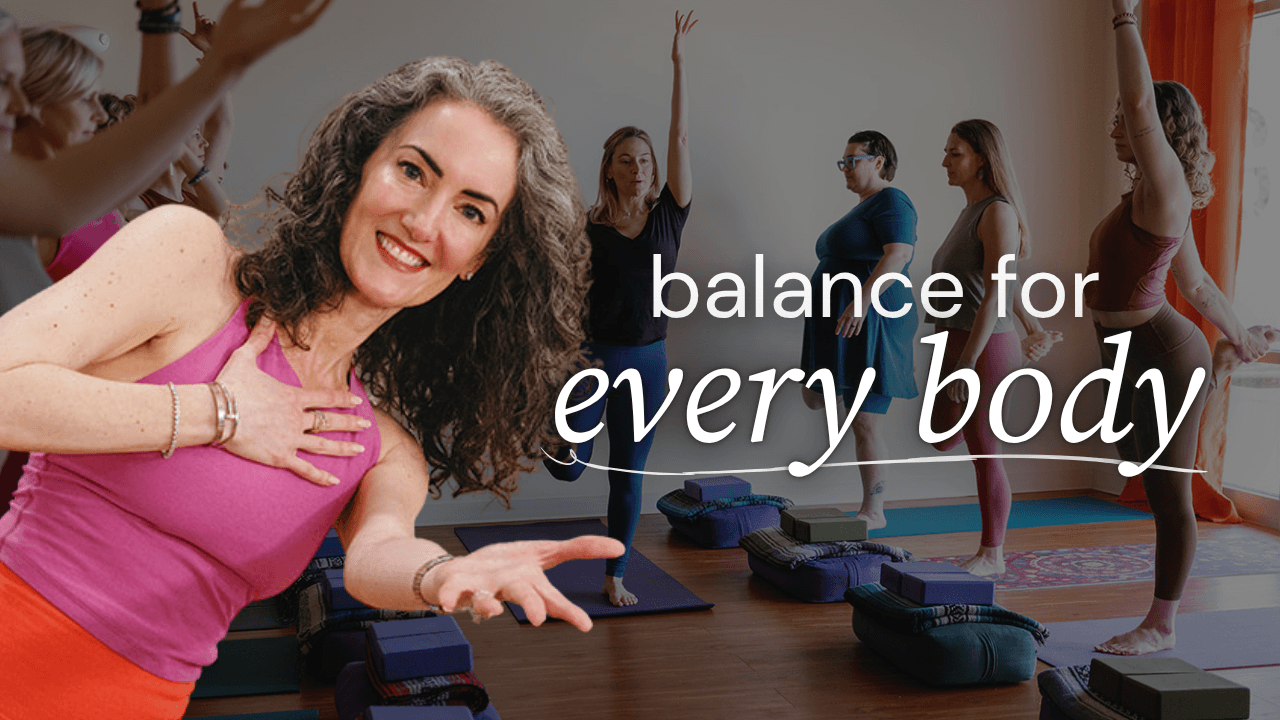
The students in your next class will arrive in a hundred different bodies, with a hundred different histories. Somebody has been balancing in tree pose for fifteen years. Somebody is coming back from a knee surgery. Somebody just grew twelve inches in a year and is still figuring out where their feet ended up. And in one hour, you’re supposed to teach all of them balance.
This was the topic the 2,500 yoga teachers inside Comfort Zone Yoga® voted to the top of the spring Comfort Zone Conversations calendar—our free monthly live workshops for working yoga teachers. What follows is the long version of what I taught: what balance actually is, why it matters on multiple levels at once, and how to build it into a class so every student in the room can succeed.
If you want the audio companion, E85 of Yoga Teacher Confidential on how to teach balance for every body covers the same foundation in podcast form.
Why teaching balance matters
Balance matters on three levels at once, and that’s a big part of why it’s such a powerful thing to teach.
Physically. Balance of the body in space is how we prevent acute injuries from falls, and the number-one predictor of a fall is a previous fall, so we’re trying to interrupt that cascade before it starts. Balance within the body—top to bottom, front to back, left to right—is also how we head off the chronic overuse injuries that pile up in active bodies: plantar fasciitis, Achilles tendonitis, patellar tendonitis, hip bursitis, all the itises my Yoga for Athletes students used to recite.
Mentally. Balance is a fast track to the intrapersonal benefits of yoga. You can’t drift in a balance pose. The second your attention wanders, you wobble. So your students get a real-time mirror for how they talk to themselves when they fall out of something, and that’s a gift. It also builds self-efficacy: the belief that their body is capable, adaptable, and theirs.
Philosophically. The root of yoga is the word yoke—the harness that brings two opposing oxen into harmony. Balance is the literal expression of that root. Every balance pose is an exercise in finding the union between effort and ease, between holding on and letting go. When you teach balance well, you’re teaching yoga on all three of those levels in the same hour.
The three systems behind every balance pose
Every balance pose is a real-time integration of three sensory systems:
- Vestibular—the crystals in your inner ear that track your relationship to gravity. Anyone who has had vertigo knows exactly how loud this system can get.
- Proprioceptive—the nerves and sensors that report where your body is in space. The wobbles are your proprioceptive system learning out loud.
- Visual—the gaze, the drishti, the fixed point that anchors you.
The most useful move you have as a teacher is to change one variable at a time. Close one eye, then the other, then blink slowly, then close both. Turn the head side to side and the vestibular load spikes. Lift the standing heel and the proprioceptive load shifts to a smaller base. Each change is one variable, and that’s how you give every student a clear path from where they are to a slightly bigger challenge—without anyone falling off a cliff.
Teaching beyond “find your drishti”
Yoga teachers are pretty good at balance. We self-selected into a practice that rewards it. So when we tell a student to “find your drishti and don’t move,” we’re often cueing from our own ability, not from the body actually standing in front of us.
The reframe is that the wobble is the practice. We’re not trying to quell the wobble; we’re celebrating it. The wobble is exactly where the nervous system learns. So when you demonstrate, let students see you wobble. Let them see you step out of a pose. If you have to fake the step-out, fake it. A teacher who never falls is teaching from a safe seat, and a class that’s afraid to fall will hold its breath through every standing shape you give it.
The sense of humor warmup
One of the most useful tools I’ve found is what I call the sense of humor warmup. I use it as the transition between the floor warmup and the standing sequence. (Sequencing is one craft among several—see the five skills your 200-hour didn’t teach.)
The setup: come up to standing from a cross-legged seat without letting the hands touch the floor. Reach the arms forward to counterbalance, lean back, press down through the outer feet, and rise. Do it on the default cross of the legs, then on the non-default cross. Then take the cross away. Then, if the room is up for it, do it from a block, then a lower block, then the floor.
I once taught this on day one of a five-day intensive at Kripalu, and almost nobody in the room could do the full no-hands version. By day five, everybody could. Their muscles hadn’t changed in a week; their nervous systems had figured out which nerves to fire. That’s the lesson your students need to feel in their own bodies, and the sense of humor warmup gives it to them in about three minutes.
The other thing it does: it lets the whole room fail on purpose and laugh about it. By the time you arrive at tree pose twenty minutes later, the pressure to “get it right” is already off.
Sequencing balance across the whole class
Most class plans treat balance as the peak—warm up, build up, big one-legged pose, cool down. I’d argue for the opposite. Sprinkle balance throughout the entire arc of the class.
- A small balance moment or two in the floor warmup.
- The transition from the floor to standing as itself a balance challenge.
- Several balance shapes across the standing sequence, including two-legged balance poses, not only one-legged ones. Try standing with the arms overhead and the heels lifted just enough to slide a piece of paper underneath, then to a sensible church-shoe heel, then to a Saturday-night stiletto. Or play with the stance: feet together, pizza-slice turnout, heels at shoulder distance, wider still. Each one redistributes the load through a different part of the foot.
- One featured pose that recurs at progressively sweeter or spicier levels. With tree pose, that might look like kickstand first, then foot to calf, then foot off the leg entirely without touching the standing leg, then arms up, then gaze up, then a slow heel lift on the standing foot.
- More balance work on the way back down to the mat. Bird dog, weight shifts in tabletop, even half moon on the knee instead of the foot—which is often spicier than the standing version, because the foot loses all of its micro-corrections.
When balance is woven through the class instead of slotted in once, no single moment has to carry the weight. Students who didn’t find their balance at minute 25 get another shot at minute 45, and that alone changes the experience of the room.
For more on building a class plan this way, my post on planning all-levels classes for yoga teachers goes deep on the structure.
Dynamic entries: drive by the party before you go in
Static balance is one skill; dynamic balance is another, and you can train both in the same class.
A dynamic entry to tree pose might look like several pulses up into a crane (knee lifted toward the chest, arms doing whatever you like), then several pulses with the leg in horizontal abduction, then short hamstring curls tapping the foot against the standing leg, and finally landing in tree. Same destination, very different conversation with the nervous system.
A dynamic entry to dancer is similar, with an internal rotation of the lifted leg so the hand can catch the foot on the way through. For warrior 3, take a warrior 1 and rock forward and back several times before committing. I think of it as driving by the pose before deciding to go in to the party. Hmm—is this a party yet? Do I want to go in? Each pulse trains the body to know exactly where it is in space, so when you do land in the held shape, the system already knows the address.
The 6–4–2 lens on balance
The framework I use to make sure a balance sequence actually balances the body is what I call 6–4–2:
- 6 moves of the spine in three planes of motion. Flexion and extension in the sagittal plane. Lateral flexion in the frontal plane. Twisting in the transverse plane.
- 4 lines of the legs. Front, back, inner, outer.
- 2 core actions. Stabilization and articulation. You articulate to get into the pose; you stabilize once you arrive.
Applied to a balance class, the 6–4–2 lens becomes a quick check—am I taking the spine in every direction across this sequence? A simple combination that hits the 6 is dancer (sagittal extension), tree pose with a side bend toward the lifted-leg side (frontal), and a standing pigeon with a twist (transverse). Add an eagle and you’ve also covered most of the four leg lines and both core actions.
If you want the full architecture, the S.E.R.V.E. Method and 6–4–2 framework post is the parent piece.
Modifications for every body in the room
Here’s how I think about modifications for the three populations most teachers tell me they struggle with.
Older students. Chair pose with the hands on the thighs, or chair pose hovering just above an actual chair. Tandem standing back to back with another student—nice for connection, which matters as much as the balance itself. Intentional walking on the heels, then the toes, then heel to toe. And the seated-to-standing-without-hands move from the sense of humor warmup, which doubles as a real-world test of independent living.
New students. Light versions of the pose with a clear physical anchor. Kickstand tree, where the ball of the lifted foot stays on the floor and the heel rests on the inner ankle. A partner block pass in tree, where two students pass a block back and forth—this disrupts the visual system, layers in dynamic balance, and upgrades what looks like the easy version of tree into a serious balance practice without singling anyone out. Toe tap games. Block in front, block behind, Simon Says style. Progressions at the wall: half moon starts with the whole back body against the wall, then just the sole of the foot, then the ball of the foot, then no wall at all.
Advanced students. Disrupt the visual system: close one eye, the other eye, slow blinks, both eyes closed. Turn the head to load the vestibular system. Add an unstable surface—a block under the standing foot, a triple-folded mat, a bolster. Use dynamic entries. And if you want the yoga teacher joke version: in tree pose with eyes closed and arms up, could you also lift the entirety of your standing foot off the floor? One of the siddhis the later books of the sutras mention.
A single class can hold all three populations if your menu is wide enough.
Sthira and sukha—the real balance
Underneath the cueing and sequencing, the actual subject of every balance pose is the same: sthira and sukha, steadiness and ease. Too much effort and the body goes rigid—you lose the fluidity you need to adapt to the wobble. Too little effort and the body goes floppy—there’s nothing to organize around. The work is the sweet spot, and the moment you find it, something shifts and you have to find it again.
That’s the practice. The pose is the doorway. What your students are really learning is how to come back to center, over and over, in real time. And the same skill that keeps a student in tree pose also helps them stay in conversation with a difficult family member, in a hard moment in a meeting, or in their own internal weather across the day.
That’s why I think teaching balance is one of the most generous things we get to do as yoga teachers.
What to do next
If you want to keep working on this kind of teaching with other teachers in real time, Comfort Zone Conversations are free, live, monthly workshops inside Comfort Zone Yoga, and they’re open to anyone in The Zone. The replay of the balance workshop is in the library, and the next call is open to anybody who shows up.
Want the sequence to teach from?
Grab Dancer, Tree, Pigeon, Eagle: The Balance Recipe—one four-pose balance sequence taught three ways (standing, core, and hips), with about twenty-one minutes of follow-along video. Free, and ready to use in your next class.
A few specific next steps:
- Free: join The Zone for future Comfort Zone Conversations and the workshop replays.
- Course: Fundamentals of Teaching Balance is the 20-CEU self-paced deep dive on everything in this post—the systems, the philosophy, the sequencing, and the cueing of balance for any body.
- Mentorship: Mastering the Art of Yoga Sequencing (MMM) is my mentorship for 200-hour-graduate teachers who want to go further with sequencing as a craft.
- Membership: The Prep Station is my monthly lesson-planning membership, with a full movement library of balance sequences—including the dynamic entries above.
For the audio version of the foundations, E85 of Yoga Teacher Confidential: How to Teach Balance for Every Body is the companion episode.

