If you’ve ever sat down to plan a themed yoga class and frozen—staring at your notebook, wondering whether to use a Sanskrit concept, a seasonal metaphor, or a quote you half-remember—you’re probably overthinking it.
And you’re not alone. Many yoga teachers have absorbed the idea that theming means becoming a philosopher. That every class needs a Big Idea. That if you’re not weaving in Sanskrit and citing ancient texts, your theme isn’t “real.”
That’s a lot of pressure. And it’s no wonder so many of us freeze before we even begin.
What a Theme Actually Is
Here’s what I’ve learned in 20+ years of teaching yoga: a theme is not a topic sentence for a philosophy essay. It’s a through-line.
Think of it as a thread that you pick up in centering, touch during a cue or two, weave into a transition, and tie off in closing. It doesn’t need to be complicated. It just needs to be present and persistent—introduced and then referred to throughout the class.
In Teaching Yoga Beyond the Poses—the books I co-authored with Alexandra DeSiato—we define a theme as an idea that deepens and enriches the experience of practice. Something that connects the physical work on the mat to something meaningful off the mat. Volume 1 offers 54 themes built around the yamas and niyamas, the koshas, and other core concepts. Volume 2 adds 54 more—themes on equity, joy, mythology, resilience, even rebellion. Together, that’s 108 themes ready to go.
But the real gift of those books isn’t the themes themselves. It’s the template. Once you see how a theme is built, you can create your own in minutes.
Why Bother Theming at All?
You could teach a well-sequenced class—good warm-up, balanced standing work, thoughtful mat sequence, solid finish—and call it a day. That is a good class. Structure matters.
But theming adds a layer that structure alone can’t provide. It gives your yoga students a reason to pay attention beyond the physical. It turns “hold this pose” into “notice what happens when you stay.” It makes your class feel like yours—not like anyone else could have taught it.
Without a theme, your students are following directions. With a theme, they’re following a story. And humans are wired for stories. We remember them. We carry them off the mat.
There’s a practical benefit, too. When you have a theme, your cueing gets easier. Instead of scrambling for something to say during a long hold, you return to the thread. “As we settle into this shape, come back to that word we started with—enough.” That cue does double duty: it fills the space and deepens the experience. You’re not performing. You’re returning to the thread.
And theming doesn’t mean every class has to be deep or heavy. A theme can be as simple as “softening” or “the exhale” or “what you already know.” The bar is way lower than you think.
The Observation Method: Choose a Theme in Sixty Seconds
The most natural and most underused method for choosing a yoga class theme is simple observation. Look at your life and notice what’s showing up. Not what you think should show up—what’s actually there.
Here’s how it works. Before you sit down to plan your class, take sixty seconds—literally one minute—and ask yourself: “What have I been noticing lately?” Write down the first thing that comes to mind. Don’t edit it. Don’t judge it. Just capture it.
Let’s say the word that comes up is “patience.” Now you have a theme. Here’s how you thread it through four touchpoints:
Centering: “Today I invite you to explore patience—not the gritting-your-teeth kind, but the kind that comes from trusting the process.”
A long hold: “This is where patience lives—right here, in the staying. Not pushing, not escaping. Just being with what is.”
A transition: “As we move from this shape to the next, see if you can carry that patience with you—letting the transition be as intentional as the pose.”
Closing: “We practiced patience today—on the mat. And here’s the thing: what you practice on the mat, you take with you.”
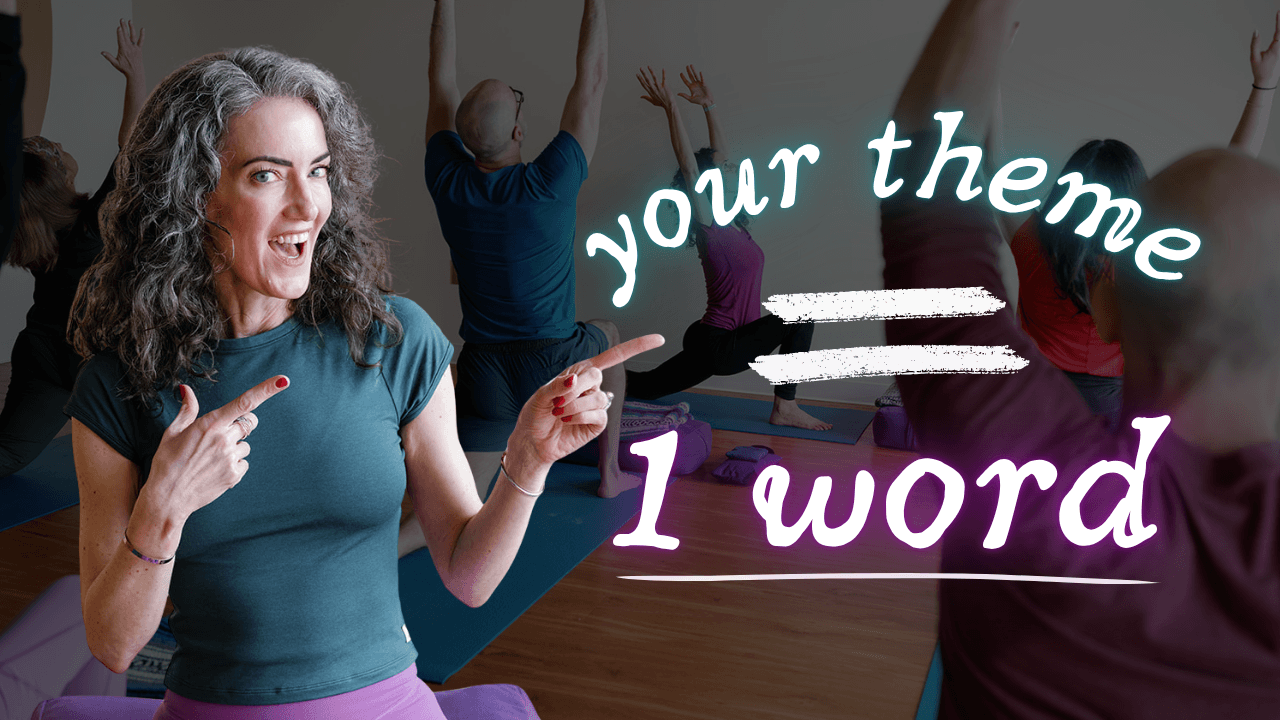
Four touchpoints. One word. Five minutes of planning—maybe less. You didn’t need to find the perfect quote or shoehorn in the Yoga Sutras. You noticed something true and let it become the thread.
Two More Methods to Try
Beyond observation, there are two equally powerful approaches:
Inquiry starts with a question instead of a word. What’s something your students are grappling with? What would you love them to explore? The question becomes the thread you return to throughout class.
Borrowed wisdom draws from something you’ve read, heard, or experienced. The 108 themes in Teaching Yoga Beyond the Poses are built for exactly this—each comes with a complete template: a quote or concept, language for centering, cues to weave through class, and a closing reflection. They’re recipes. And once you understand the recipe, you start cooking on your own.
Your Takeaway
Theming your yoga classes doesn’t have to be a production. You don’t need to be a philosopher. You need one word, one thread, and four places to touch it—centering, movement, stillness, and closing.
Your students aren’t looking for a lecture. They’re looking for something to hold onto—something that makes your class feel cohesive and intentional. And you already have what you need to give them that. You notice things. You care about your students’ experience. That’s enough.
Want to go deeper? I’m hosting a free Comfort Zone Conversation on April 9 at 2 p.m. Eastern, where we’ll take one theme and build it together from a single word to a woven class plan. Join us in the Zone to RSVP—it’s free, and the recording will be available afterward.
For 108 ready-made themes with full templates, pick up Teaching Yoga Beyond the Poses and Volume 2—available wherever books are sold.
And for the full class-arc framework—how theming fits into your overall class structure using the S.E.R.V.E. Method—that’s what we go deep on in Mastering the Art of Yoga Sequencing.