You Don’t Need a Velvet Voice or a Mystical Presence to Guide Deep Rest
Some yoga teachers hear the word “nidra” and immediately think: that’s not for me. They picture someone with a voice that fills the room like incense and a presence that seems almost otherworldly. They assume that guiding nidra requires some kind of natural talent they weren’t born with.
I’ve watched hundreds of yoga teachers learn to guide nidra over the past 20+ years. Teachers with loud voices, quiet voices, fast-talking brains, and shaky hands. Every single one of them got better by doing the same thing: following a recipe and practicing.
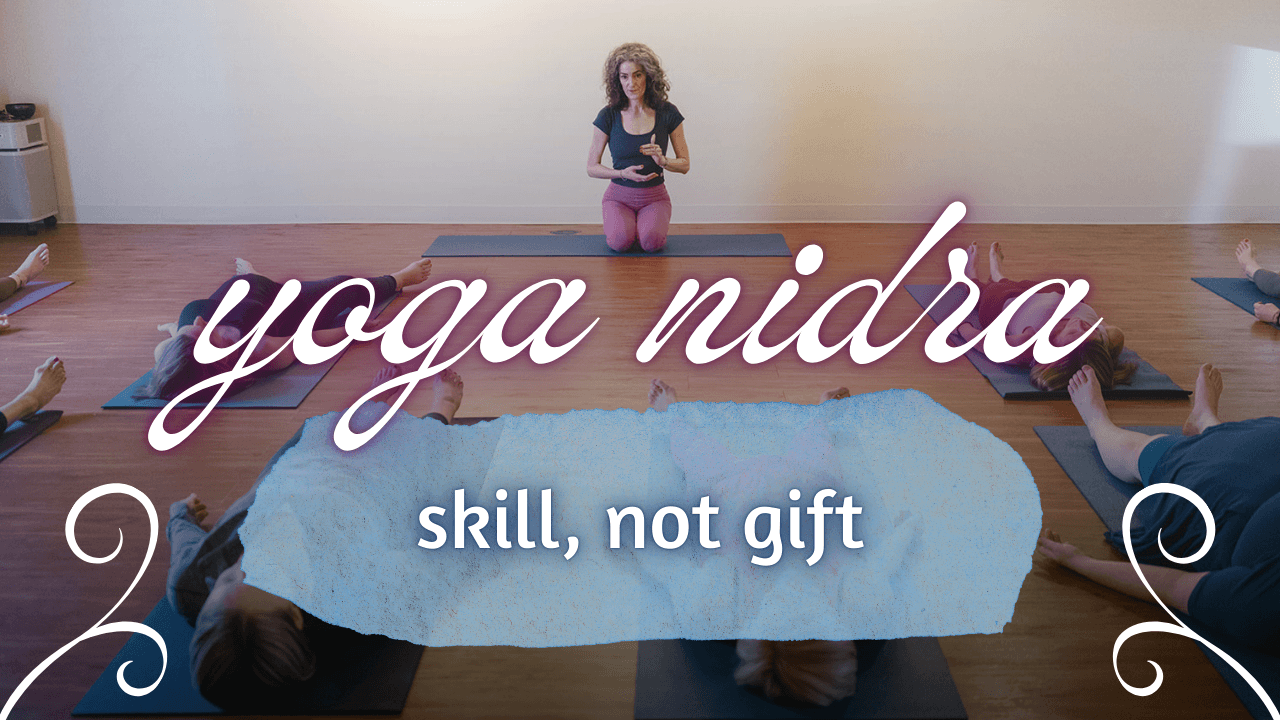
Teaching yoga nidra is not a gift. It’s a skill. And I’m going to break down exactly why.
Where the “Gift” Myth Comes From
Most of us experienced yoga nidra for the first time as students. Someone guided us through a practice, and it was . . . powerful. Maybe we cried. Maybe we fell into the deepest rest we’d had in months. Maybe we woke up and thought: How did they do that?
Because the experience felt almost magical, we assumed the teacher must be magical, too. We confused the power of the practice with the personality of the practitioner.
Yoga nidra is inherently powerful. The structure of the practice—moving awareness through layers of the body and mind—does most of the heavy lifting. A good nidra script, delivered clearly and calmly, will land with your students even if your voice shakes. Even if you read every word off a page. Even if you’re nervous the whole time.
The practice works because of its design, not because of your charisma. If you’ve ever felt the same kind of doubt about teaching meditation, this reframe applies there, too.
The Four Actual Skills of Teaching Nidra
If teaching nidra isn’t a gift, what is it? Let me break it down.
Skill 1: Following a structure. Yoga nidra has a recipe—body, breath, brain, belly, bliss. If you can follow five steps in order, you can guide a nidra session. You’re not improvising a jazz solo. You’re cooking from a recipe.
Skill 2: Pacing. This one feels hardest at first. Nidra asks you to slow down—to leave space between your words, to let silence do some of the work. Most new nidra teachers talk too fast and fill every gap. The fix? Practice. Record yourself. Listen back. You’ll naturally slow down as you get comfortable with the quiet.
Skill 3: Reading a room (or a Zoom). Over time, you’ll start to sense when your students are settling in and when they’re restless. You’ll learn when to linger on a body scan and when to move on. But this is advanced. You don’t need it to start.
Skill 4: Trusting the process. This is the mindset piece. You have to trust that the practice works—even when you can’t see it working. Your students’ eyes are closed. They’re not nodding along or giving you feedback in real time. You guide them, you hold the space, and you trust the recipe.
Four skills. All learnable. None of them require a special voice, a specific personality, or years of silent meditation retreats. And if building confidence as a yoga teacher is something you’re working on more broadly, know that nidra is one of the best places to start—because the recipe carries you while you grow.
Teaching Nidra Is Like Cooking
I use this metaphor a lot because it holds up.
The first time you cook a new dish, you follow the recipe exactly. You measure everything. You check the instructions three times. It’s not elegant. But the food is good—because the recipe is good.
The tenth time you make it, you’re faster. You know which step takes the longest. You start adjusting the seasoning by taste.
The fiftieth time? You barely look at the recipe. You’ve made it yours.
Teaching nidra works the same way. The first few times, you’ll read from a script. That’s not cheating—that’s smart. The recipe carries you. And over time, your confidence grows, your pacing improves, and your voice relaxes. Not because you found some hidden gift. Because you practiced a skill.
This is the same principle behind why your yoga students actually want repetition. The recipe gets better every time you make it—for you and for them.
Your First Session Won’t Be Your Best
Let me say this directly: your first yoga nidra session will not be your best. And that’s completely fine.
Your voice might waver. You might lose your place. You might speak too fast or leave a pause that feels uncomfortably long. Your students will still benefit. The structure of the practice will still work.
I’ve seen teachers guide their very first nidra and have students come up afterward and say, “That was exactly what I needed.” Not because the teacher was perfect—but because the practice met the student where they were.
You don’t need to be flawless. You need to be willing to start.
If you’re wondering how nidra fits alongside other restful practices you might already teach, I break down the differences in yoga nidra vs. restorative yoga. They complement each other beautifully, and understanding the distinction will make you a stronger teacher of both.
Ready to Start Building the Skill?
If you want to practice right now, grab my free 5-minute yoga nidra script. Read it to a friend. Read it to your cat. Read it to yourself. The point is to start.
And if you want the complete system—the full recipe, annotated scripts, video lectures, and a custom GPT for building your own sessions—check out my course, Teaching Yoga Nidra. Twenty Yoga Alliance CEUs, designed for real yoga teachers with full schedules. It also counts toward your 300-hour training.
Teaching nidra is a recipe, a practice, and a decision to start.
Learn to Teach Yoga Nidra with Confidence
If you’re ready for the full recipe—not just a taste—my course Teaching Yoga Nidra gives you everything you need to guide deep rest on your own terms. Inside you’ll find the master recipe, annotated scripts at three different lengths, fifteen video lectures (with a private podcast feed for learning on the go), a custom GPT for brainstorming your own sessions, and a workshop planning guide so you can start offering nidra right away.
The course is self-paced, earns 20 Yoga Alliance CEUs, and counts toward your Comfort Zone Yoga 300-hour training.