
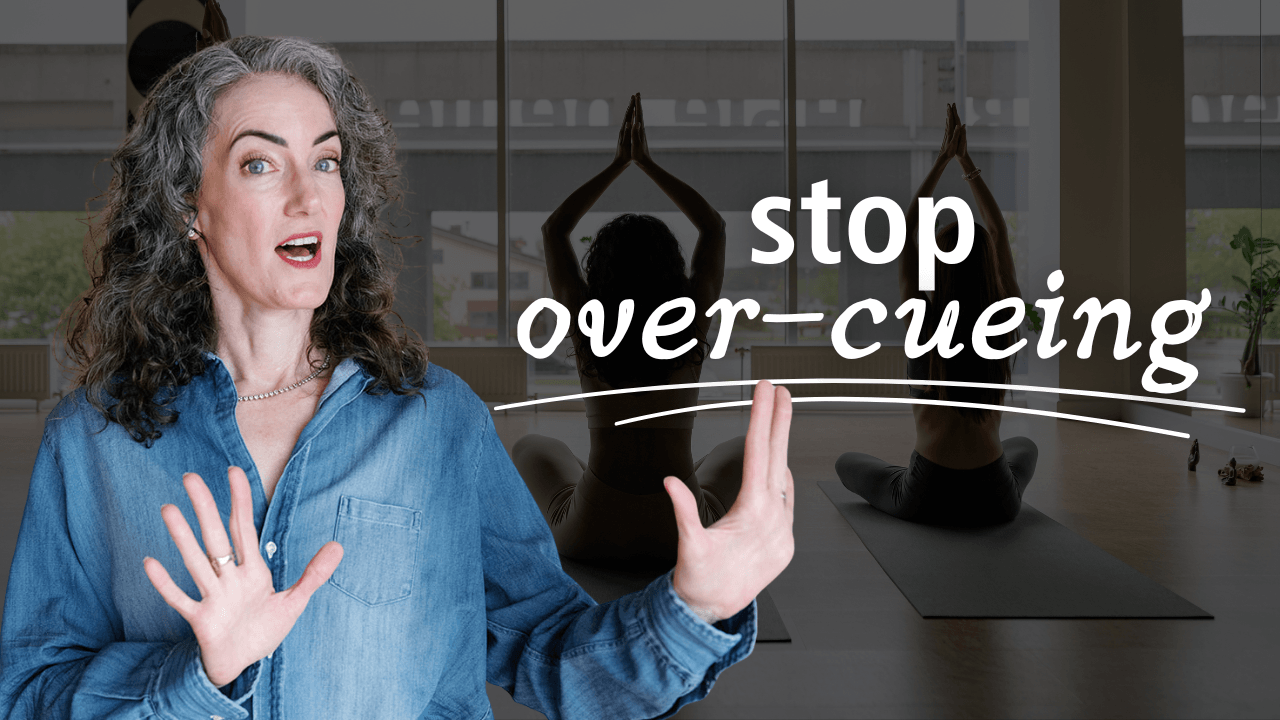
One cueing habit is costing teachers their students, and most of us never notice we’re doing it
Picture a student in your class. Her front foot landed exactly where it needed to. Her hips found a steadiness. Her breath dropped. And then your voice arrives with six instructions at once: stack the front knee, angle the back foot, square the hips, drop the shoulders, lengthen the tailbone, lift the crown. She catches maybe one of them.
She isn’t a bad student. She’s a student whose body already knew, and now her brain is busy translating a checklist into something she had already done. The shape gets tighter. The breath gets shallow. Her felt experience leaves the room.
That’s the habit I see in so many thoughtful teachers: over-cueing the position and under-cueing the feeling. The good news is that the fix has nothing to do with your vocabulary. It lives in the edit. Below are three language shifts you can try in your very next class, plus the teaching mindset that holds them together. (This is the cueing companion to my video on finding your authentic teaching voice.)
Shift one: edit before you cue
Great cueing is editing. One sentence that lands beats three that drift past. Hear the difference:
OK cue: “Place your right foot forward at the top of your mat and ground through all four corners of your foot, rooting down through your heel and the ball of your big toe.”
Great cue: “Right foot forward. Feel your foundation.”
Same shape. Half the words. Twice the room for the student to feel. The edit shows the student you trust their body to know what your sentence is asking for. If you tend to overthink every word, my 3-Cue Rule is a simple way to practice cutting back.
Shift two: cue the feeling, not just the position
The shape is the syllabus. The feeling is the lesson. If your cue only describes position, you’ve handed the student a homework assignment instead of a practice.
Position only: “Square your hips toward the front of the mat.”
Feeling and position together: “Notice where your hips want to go. Find a steadiness there.”
Position only: “Bring your hands to prayer at your heart center.”
Feeling and position together: “Hands to your heart. Notice the warmth.”
Name the feeling and you give the student something to come home to. The body finds the shape on its own.
Shift three: prescribe direction, invite variation, reserve consent
This shift changes the whole tenor of your class, and it’s the easiest one to get wrong in either direction. Lean too directive and you sound like a drill sergeant. Lean too soft and every cue starts with “when you’re ready” until the phrase means nothing—including in the moments students actually need it.
Three things are happening inside any cue, and each one calls for a different kind of language:
- Direction gets a clear prescription. “Right foot forward.” “Forward fold.” “Hands to your heart.” The body knows what to do with a direct verb.
- Variation gets an invitation. Name the spectrum the shape lives on, then let the student choose: “Tall lunge or deep one—let your front knee choose.” “Bent knees or straight—wherever your spine lengthens most.”
- Consent is where full invitation language belongs. Save “when you’re ready” and “skip this one if it’s not for you” for the moments that genuinely call for it: closed eyes, a deep hip opener, a bound shape, a hands-on assist, a breath retention.
Those invitations land because you didn’t use them on every cue. The room hears that this one is different. Teaching this way is a conversation, not a script—something I dig into more in why teaching yoga is a conversation.
The mindset underneath all three: Movement Optimism
The three shifts share one source: Movement Optimism. It’s the embodiment of the trust we extend to students when we tell them, “You are the expert on you.”
Edit your cueing and you trust the student’s body to know. Cue feeling alongside position and you honor the felt experience as the practice itself. Invite rather than prescribe and you hand expertise back where it belongs. That kind of teaching is confident. Soft is the wrong word for it. Your students will tell you with their feet—they keep coming back.
Where to go next
The most generous cue you can give a student is the one that helps them feel. Cut the rest. If you want to start before your next class, pick one shift and try it tomorrow.
And if you’d like to refine your cueing alongside other teachers doing the same work, come into the Zone. It’s our free community of 3,400+ yoga teachers, where we share class experiences, swap cueing edits, and workshop language together.

