
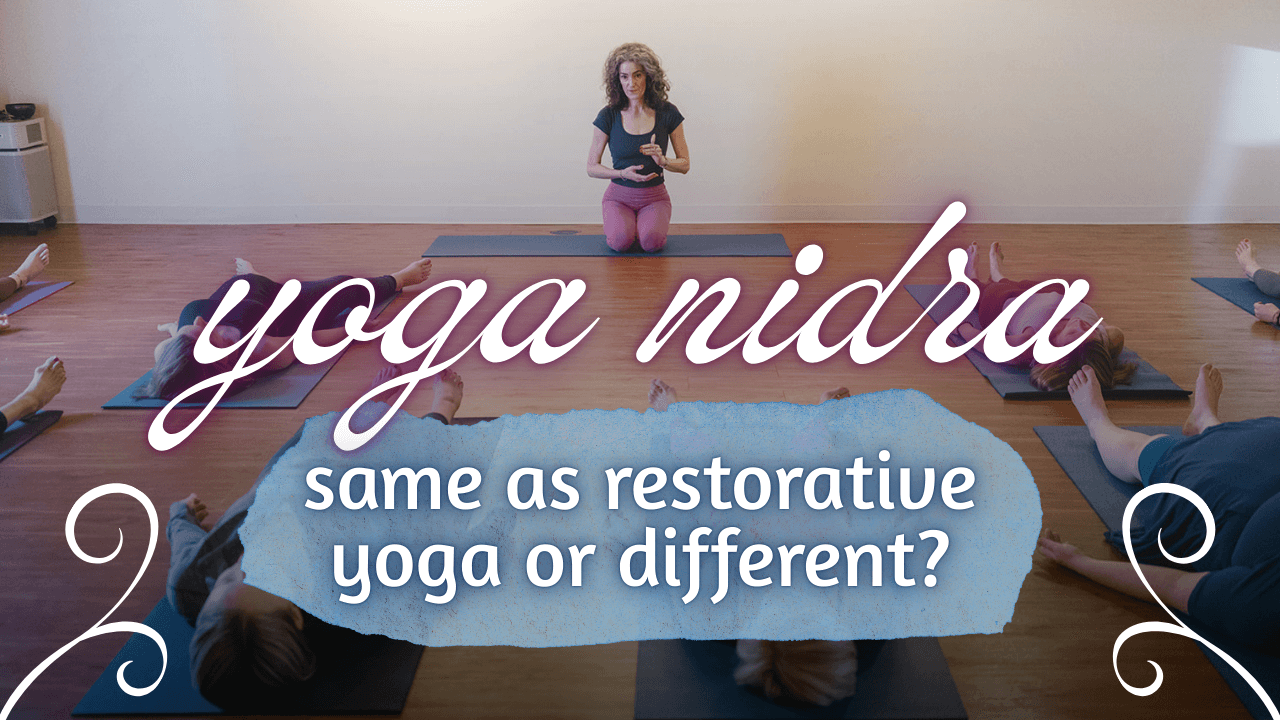
They’re Both Restful—But They’re Not the Same Practice
If you already teach restorative, nidra is closer than you think—it can close your very next class. Grab the free 5-Minute Yoga Nidra Script and try it at the end of savasana.
Restorative yoga and yoga nidra are both restful, but they work through different mechanisms. Restorative yoga restores the body: you set students up in supported poses with props and hold those shapes for five to twenty minutes while the body releases tension passively. Yoga nidra restores awareness: students lie in one position, usually savasana, while you guide their attention through internal layers—body sensations, breath, emotions, visualization, stillness—with no pose transitions at all. In restorative, you’re an architect designing the physical environment for rest. In yoga nidra, you’re a narrator guiding an inner journey.
Last updated: July 6, 2026
If you teach restorative yoga and someone asks you to teach yoga nidra, your instinct might be: Isn’t that what I’m already doing?
The answer is: not quite.
Yoga nidra and restorative yoga share a lot of surface-level similarities. Both are restful. Both usually involve lying down or reclining. Both use props. Both are slower than a vinyasa class. And both are deeply needed by your students, who are overstimulated, overworked, and craving permission to stop.
So the confusion makes sense. But these two practices diverge in important ways—and understanding those differences will make you a more confident, versatile teacher.
In this video, I break down exactly where restorative yoga ends and yoga nidra begins.
Yoga Nidra vs. Restorative Yoga: What’s the Difference? (For Yoga Teachers)
The Core Difference: Body vs. Awareness
Here’s the clearest way to think about it:
Restorative yoga restores the body. You set students up in supported poses—bolsters, blankets, blocks—and hold those shapes for five to twenty minutes each. The props do the work. The body releases tension passively. The intelligence is in the propping.
Yoga nidra restores awareness. Your students lie in one position—usually savasana—and you guide their attention through a series of internal layers: body sensations, breath, emotions, visualization, stillness. There are no pose transitions. The intelligence is in the guiding.
In restorative, you’re an architect—designing the physical environment for rest. In yoga nidra, you’re a narrator—guiding an inner journey through layers of experience.
A Side-by-Side Comparison for Teachers
Setup
In restorative, setup is everything. You might spend several minutes getting each student into a supported shape with exactly the right prop configuration. In yoga nidra, setup is simple—savasana with support—and then you don’t touch the props again.
Your Role During the Practice
In restorative, you’re circulating—adjusting props, offering hands-on assists, transitioning students between shapes. In yoga nidra, you sit or recline in one spot and guide with your voice. You don’t move around the room.
Number of Positions
Restorative uses three to five supported poses over the course of a session. Yoga nidra uses one. Students lie down at the start and don’t move until you bring them back.
The Student’s Experience
In restorative, students are aware of the room—the props, the temperature, the sounds. In yoga nidra, students often lose track of the room entirely. They’re following your voice inward. Some describe it as dreamlike.
What You Need to Know to Teach Each One Well
Restorative requires strong propping skills and an understanding of anatomy in supported shapes. Yoga nidra requires a framework for guiding attention through layers of awareness—and the confidence to hold silence.
Why You Should Offer Both
This isn’t a competition. Restorative and yoga nidra are complementary.
Some students need restorative yoga—their bodies are tight, sore, recovering. They need the passive stretch, the supported opening, the physical release.
Some students need yoga nidra—their minds are racing, their nervous systems are fried, they can’t sleep. They need the guided inward journey, the mental reset, the permission to stop thinking.
And many students need both. A restorative class with a nidra tucked into savasana is one of the most powerful offerings you can put on a schedule. The body rests in the poses. The mind rests in the nidra. Your students leave feeling like they’ve had a full reset.
Want the best savasana your students have ever had? Grab my free guide, Best Savasana Ever: The Six Supports—six prop choices that turn a flat savasana into a full nervous-system reset, with a video demo you can use in your next class tonight.
Start Teaching Yoga Nidra Tonight
If you already teach restorative, you’re halfway there. You understand rest, pacing, and silence. Learning to teach nidra adds a powerful new tool to your kit.
Grab my free 5-minute yoga nidra script—it follows a simple five-step recipe (body, breath, brain, belly, bliss) and you can read it to your students tonight. Try it at the end of your next restorative class and see what happens.
👉 Download the Free 5-Minute Yoga Nidra Script
And if you want the complete system—the full framework, annotated scripts, video lectures, and a custom GPT for building your own sessions—check out my course, Teaching Yoga Nidra. It confers 20 Yoga Alliance CEUs, and it’s designed for working yoga teachers.
What is the difference between yoga nidra and restorative yoga?
Restorative yoga restores the body through supported poses held for five to twenty minutes, with props doing the work. Yoga nidra restores awareness through one still position, usually savasana, while you guide students’ attention through internal layers with your voice alone.
How many poses does restorative yoga use compared to yoga nidra?
Restorative uses three to five supported poses over a session. Yoga nidra uses one—students lie down at the start and don’t move until you bring them back.
What does the teacher do differently in restorative yoga versus yoga nidra?
In restorative, you’re circulating—adjusting props, offering hands-on assists, transitioning students between shapes. In yoga nidra, you sit or recline in one spot and guide the whole practice with your voice, without moving around the room.
Can you combine restorative yoga and yoga nidra in one class?
Yes, and many students need both. A restorative class with a nidra tucked into savasana lets the body rest in the poses and the mind rest in the nidra, so students leave with a fuller reset than either practice alone.
If I already teach restorative yoga, is yoga nidra hard to learn?
No. If you teach restorative, you already understand rest, pacing, and silence—the core skills yoga nidra also asks for. Learning to teach nidra mostly means adding the narrator’s skill of guiding attention with your voice.

