
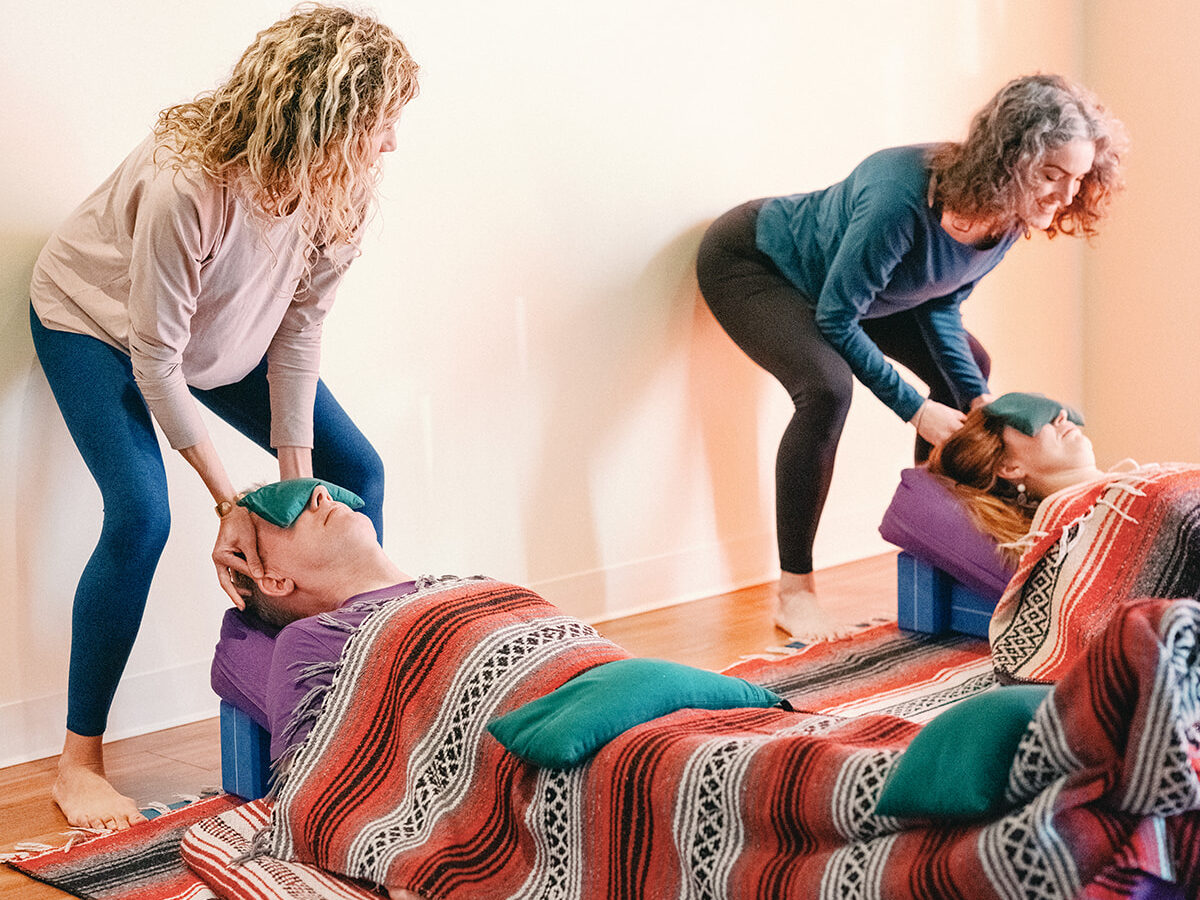
You’ve been teaching restorative yoga from what you picked up in your 200-hour training—a few supported poses you remember, some blanket folding you figured out on your own, and a general sense that students should relax. It works . . . sort of. But you know there’s more to it. Real restorative yoga teaching requires understanding why props go where they do, how the nervous system responds to specific shapes, and how to sequence a class that builds toward genuine deep rest—not just lying around.
That’s what a restorative yoga teacher training gives you: the craft behind the calm.
What a Restorative Yoga Teacher Training Actually Covers
A quality restorative yoga teacher training goes well beyond “put a bolster under the knees.” Here’s what you should expect to learn:
Nervous system science. Restorative yoga works because it shifts the nervous system from sympathetic (fight-or-flight) to parasympathetic (rest-and-digest) dominance. Understanding this mechanism changes how you set up poses, how long you hold them, and how you cue transitions. It also gives you the language to explain to students—and studio owners—why this practice matters.
Prop setup and support. The difference between a restorative pose that works and one that doesn’t usually comes down to inches of prop placement. You need to know the purpose of each prop, the adjustments for different body types, and the common mistakes that leave students uncomfortable instead of supported. This is hands-on craft, not theory.
Sequencing for deep rest. A restorative class isn’t just a series of supported poses strung together. There’s an arc—a deliberate progression that helps students settle in, go deeper, and come back. Learning to build that arc is what separates a restorative class that students tolerate from one they can’t stop talking about.
Cueing that gets out of the way. In a vinyasa class, your voice is a constant guide. In restorative, less is more—but less still has to be precise. Learning when to speak, when to stay quiet, and how to use your voice to deepen rest rather than disrupt it is one of the most valuable skills you’ll develop.
Class frameworks you can use immediately. The best trainings don’t just teach you concepts—they give you ready-to-teach templates you can bring to your next class. Look for a program that includes complete class plans alongside the theory.
Why Restorative Yoga Is Worth Specializing In
Restorative yoga is consistently one of the most requested workshop topics at yoga studios. Students crave it, studio owners know it fills seats, and the yoga teachers who can teach it well are in demand.
But here’s what many yoga teachers don’t realize: learning to teach restorative well doesn’t just give you a specialty. It levels up every class you teach. When you understand how to create genuine rest in savasana, every single class you lead—vinyasa, gentle, yin, whatever—has a stronger finish. Your students leave feeling more complete. That’s the ripple effect of this training.
Restorative yoga teaching also deepens your understanding of the nervous system in ways that make you a better yoga teacher across the board. You start to see how pacing, cueing, and sequencing all affect your students’ nervous systems—not just in restorative class, but in every class.
What to Look for in a Restorative Yoga Teacher Training
Not all restorative yoga teacher trainings are created equal. Here’s what matters:
Yoga Alliance recognition. If continuing education hours matter to you (and they should for maintaining your RYT credential), make sure the training is registered for Yoga Alliance CEUs. A 20-hour program earns you 20 CEUs—a meaningful chunk of your renewal requirements.
Practical over theoretical. A good training gives you poses, sequences, and class frameworks you can teach immediately—not just lectures about the parasympathetic nervous system. Both matter, but the practical application is what actually changes your teaching.
Counts toward advanced certification. The smartest investment is a restorative yoga teacher training that also counts toward your 300-hour yoga teacher training. That way you’re building a specialty and earning credential hours at the same time. (The same is true if your interest runs toward trauma-informed yoga teacher training—another specialty that deepens every class you teach and counts toward the 300-hour.)
Self-paced format. Most yoga teachers juggle teaching with other work. An online, self-paced restorative yoga teacher training lets you learn on your schedule without pausing your teaching life for a weekend intensive.
Online vs. In-Person Restorative Yoga Teacher Training
The instinct is to think restorative yoga training needs to be in person because it’s so prop-heavy. But a well-designed online program actually has advantages: you can see close-up prop placement demonstrations that are hard to spot from across a workshop room, you can rewatch setup tutorials as many times as you need, and you can practice teaching in your own space with your own props before bringing it to students.
The key is making sure the online program includes detailed visual instruction—video demonstrations of every prop setup, adjustment variations for different body types, and clear before-and-after examples of common mistakes.
How Restorative Yoga Teacher Training Fits Into Your Career
If you’re a yoga teacher who already teaches some restorative—even if it’s just a longer savasana or a few supported poses mixed into gentle class—a formal restorative yoga teacher training is the fastest way to go from “I kind of do this” to “this is my thing.”
Studios notice when a yoga teacher can lead a genuinely effective restorative class. It’s a specialty that opens doors to workshops, series, corporate wellness sessions, and private clients who specifically need stress management. In a crowded field of yoga teachers who all teach vinyasa, restorative expertise makes you stand out.
And if you’re working toward your 300-hour yoga teacher training certificate, a restorative module is one of the most practical specialty courses you can choose. It gives you skills you’ll use in literally every class you teach.
Want the best savasana your students have ever had? Grab my free guide, Best Savasana Ever: The Six Supports—six prop choices that turn a flat savasana into a full nervous-system reset, with a video demo you can use in your next class tonight.
Teaching Restorative Yoga at Comfort Zone Yoga®
My Teaching Restorative Yoga course is a 20-hour, self-paced online training that covers nervous-system science, prop setup and support, ready-to-teach class frameworks, and cueing for deep rest. It earns you 20 Yoga Alliance CEUs and counts toward the Comfort Zone Yoga 300-hour yoga teacher training.
The course is built the same way I build everything: with a craft-centered approach that gives you structure first, then the confidence to make it your own. You’ll leave with complete class frameworks, not just a pile of poses—and you’ll know exactly why each element works.
If you’re wondering whether this is the right next step for your teaching, take the pathway quiz on the 300-hour training page—or email me directly at [email protected].
Do I need a certification to teach restorative yoga?
No specific certification is required to teach restorative yoga if you already hold your RYT-200. However, a dedicated restorative yoga teacher training gives you the prop skills, nervous-system knowledge, and sequencing frameworks that make the difference between a class that’s just quiet and one that’s genuinely transformative. It also earns you continuing education hours toward your Yoga Alliance renewal.
How long does a restorative yoga teacher training take?
Most restorative yoga teacher trainings range from 20 to 40 hours. A 20-hour program—like the Teaching Restorative Yoga course at Comfort Zone Yoga—covers nervous-system science, prop setup, class frameworks, and cueing. Self-paced online formats let you complete the training over weeks or months, fitting it around your teaching schedule.
Can I do a restorative yoga teacher training online?
Yes. A well-designed online restorative yoga teacher training includes detailed video demonstrations of prop setups, adjustment variations, and complete class templates. The online format has real advantages: you can rewatch techniques, practice in your own space, and learn without pausing your teaching life for a weekend intensive.
Does restorative yoga teacher training count toward my 300-hour certification?
It depends on the program. The Teaching Restorative Yoga course at Comfort Zone Yoga counts toward the 300-hour yoga teacher training, so you’re building a specialty and earning credential hours at the same time. This is the most efficient path if you’re working toward your RYT-500.

