
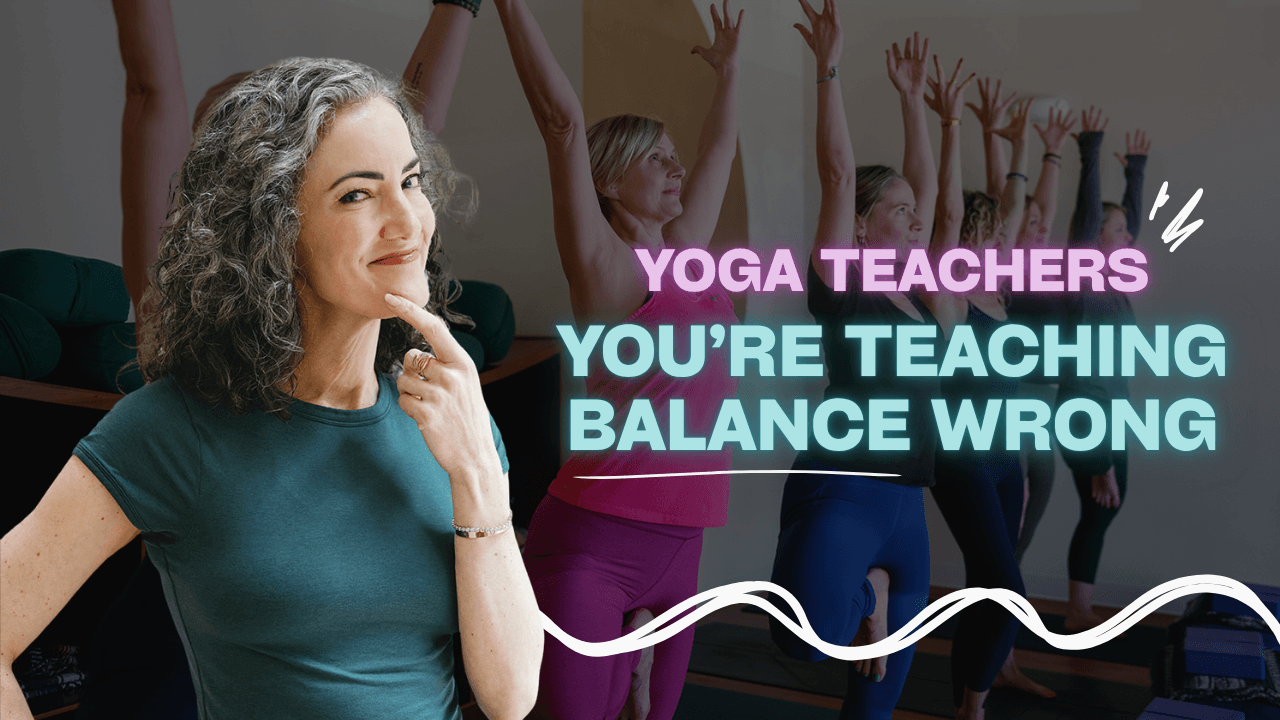
A few years ago, I was at the doctor’s office for an X-ray on a “sprained” ankle that wouldn’t heal. I’m an ultrarunner, which means I roll my ankles on trails for sport. The doctor—not knowing I’d been teaching yoga for over twenty years—kindly suggested I try standing on one leg.
Easy. Close my eyes? Easy. Turn my head side to side? Still easy.
And I stood there in the fluorescent-lit clinic thinking: how can I have textbook balance here and still be rolling my ankles every other week on the trails?
The answer is that balance is not one thing. It’s a whole system of things. What holds you up on a linoleum floor is different from what holds you up on roots and dappled light. Your students feel this in their bodies even if they can’t name it—because balance shifts on them constantly, from day to day, from room to room, from the mat to the stairs at their kid’s school.
When we teach balance as if it’s just tree pose on the right, tree pose on the left, and maybe eagle if we’re feeling fancy, we’re selling it short. We’re selling our students short.
Why Traditional Balance Cues Leave Students Behind
Most of us were taught to teach balance the same way. Get students upright, pick a standing balance pose, cue “fix your gaze,” “engage your core,” “root down through the standing foot,” and hope.
Those cues aren’t wrong. They’re just incomplete. They’re written for a specific body, on a specific day, in a specific room. Which means they work for some of your students some of the time, and leave the rest either clinging to the wall or standing perfectly still looking bored.
There’s another thing in the room whether we talk about it or not: when a student wobbles, they usually feel embarrassed. They read it as failure. And if we don’t actively reframe that, we reinforce the shame. We train them to avoid balance work.
This matters more than most teachers realize. The highest correlated indicator of a future fall is a previous fall. Which means fear matters. Avoidance matters. How you talk about balance in your classroom is either expanding your students’ relationship with balance or quietly shrinking it.
So let’s do better.
The Four Systems Behind Every Balance Pose
Once you understand the physiology, your cueing gets dramatically more precise. When a student stands on one foot, four systems run in the background in real time.
The vestibular system is your inner ear—the internal gyroscope that detects where your head is in space. If you’ve ever had vertigo, you’ve met it.
Proprioception is your sixth sense—the receptors in your muscles, tendons, and joints that tell your brain where your body parts are without looking. This is why an old ankle sprain can leave a student’s balance uneven on that side in a way they can’t quite name.
Vision gives your brain depth, movement, and lines in the room to help you stay upright. Close your eyes in a balance pose and notice how loudly your other systems have to shout.
The musculoskeletal system is the bones, joints, muscles, and connective tissue doing the structural work—strong feet, available ankles, engaged hips, a spine that can move.
These four systems don’t work in isolation. They’re constantly talking to each other through the brain—specifically the cerebellum, the brainstem, the parietal lobes, and a reflex called the vestibulo-ocular reflex that lets you read a sign while you’re walking.
Here’s the hopeful part: the brain is plastic. It rewires in response to practice. When you teach balance well, you’re literally helping your students lay down new neural pathways—at any age.
Balance Is Also Psychological
Fear changes the answer. When a student is afraid of falling—because they’ve fallen before, because a friend broke a hip last year, because they don’t trust their knee—their body tenses. That tension actively interferes with the micro-adjustments that good balance requires. Fear makes balance harder, mechanically.
The antidote isn’t bravado. It’s self-efficacy—the belief that you can adapt and recover. And self-efficacy is built in small, specific wins. Holding a pose one breath longer. Trying a new variation. Stepping down on purpose instead of falling out by accident. Those micro-successes are not fluff. They are the nervous system learning that it’s safe to try.
Your job as the teacher is not to prevent wobbling. It’s to build the classroom where wobbling is allowed.
Five Practical Shifts for Your Next Class
Here’s how to take all of that and put it on the mat in your very next class.
1. Put balance in every quarter of class, not just the balance slot.
Balance isn’t a peak-pose moment—it’s a thread that runs from warm-up to cool-down. In the warm-up, use small weight shifts and slow transitions from the floor up to standing. In standing, pair classic single-leg work with balance in motion: Warrior II pulsing into tree pose on the back leg, Warrior I rocking into Warrior III, pyramid into hand-to-knee. On the floor, use balance poses that don’t look like balance poses—bird dog, half moon on the knee, eagle crunches, boat. The core work and the balance work are the same work.
2. Use the 6–4–2 to teach in all three planes.
If you’ve read The Art of Yoga Sequencing, you know the 6–4–2: six moves of the spine, four lines of the legs, two core actions. In a balance-focused class, make sure you’re offering balance in all three planes of motion. Sagittal (Warrior III, chair on tiptoes, crane). Frontal (tree, half moon, standing splits to the side). Transverse (figure four, curtsy, twisted chair). Your students don’t live on a flat mat.
3. Offer a sweeter-to-spicier spectrum.
Instead of one pose with one cue, offer a continuum. For tree pose, the spectrum might run from hand at the wall, to hand on a chair, to foot at the ankle, to foot at the inner calf, to foot at the inner thigh—then arms low, arms wide, arms up, soft gaze, closed eyes, toes of the standing foot lifted. There is always a next level. You don’t have to hand the whole spectrum to every student, but you need to know it’s there so you can meet the room where it is.
4. Cue the system, not just the shape.
Once you know the four systems, your troubleshooting gets better. If a student is hyper-focused on their gaze and frozen, they’re over-relying on vision—soften the gaze, add a slow head turn. If the standing foot looks dead, work proprioception: spread the toes, lift and lower the toes, press through the mounds. If the hip is collapsing, that’s a musculoskeletal conversation about strength and stacking. If they’re holding their breath, that’s fear, and the cue is permission: “Step down, reset, try again. Wobbling means your nervous system is getting new information.”
5. Change your language so wobbling is a feature, not a bug.
This one costs nothing and changes the whole room. A few phrases you’re welcome to steal:
- Wobbling means you found an edge.
- Every wobble is your body recalibrating.
- Trees that can bend in the wind are the ones that grow and thrive.
- This is practice, not performance.
- You can always step down and step back up—that counts.
- There’s always a next level, and today you get to pick it.
That last one matters a lot. The moment you hand agency back to the student, balance stops being a test you’re giving them and starts being an experiment they’re running. That is a totally different classroom.
The Classroom Where This Actually Happens
People like to say life begins beyond your comfort zone. There’s another definition of comfort zone I love much more: the comfort zone is the place where you can operate without fear of failure. That is exactly what I want your yoga classroom to be. A place where students can take risks, wobble, fall out with a sense of humor, and come back in. That’s where expansion actually happens—from the inside out.
If you want to go deeper on this, I’m hosting a free Comfort Zone Conversation called Balance for Every Body on Thursday, May 21, at 2 p.m. Eastern.
Want the sequence to teach from?
Grab Dancer, Tree, Pigeon, Eagle: The Balance Recipe—one four-pose balance sequence taught three ways (standing, core, and hips), with about twenty-one minutes of follow-along video. Free, and ready to use in your next class.
And the full self-paced training, Fundamentals of Teaching Balance, is open now—20 hours of continuing education, lifetime access, and everything I teach on the physiology, psychology, and sequencing of balance.
Want the full episode? Listen to Yoga Teacher Confidential here.

