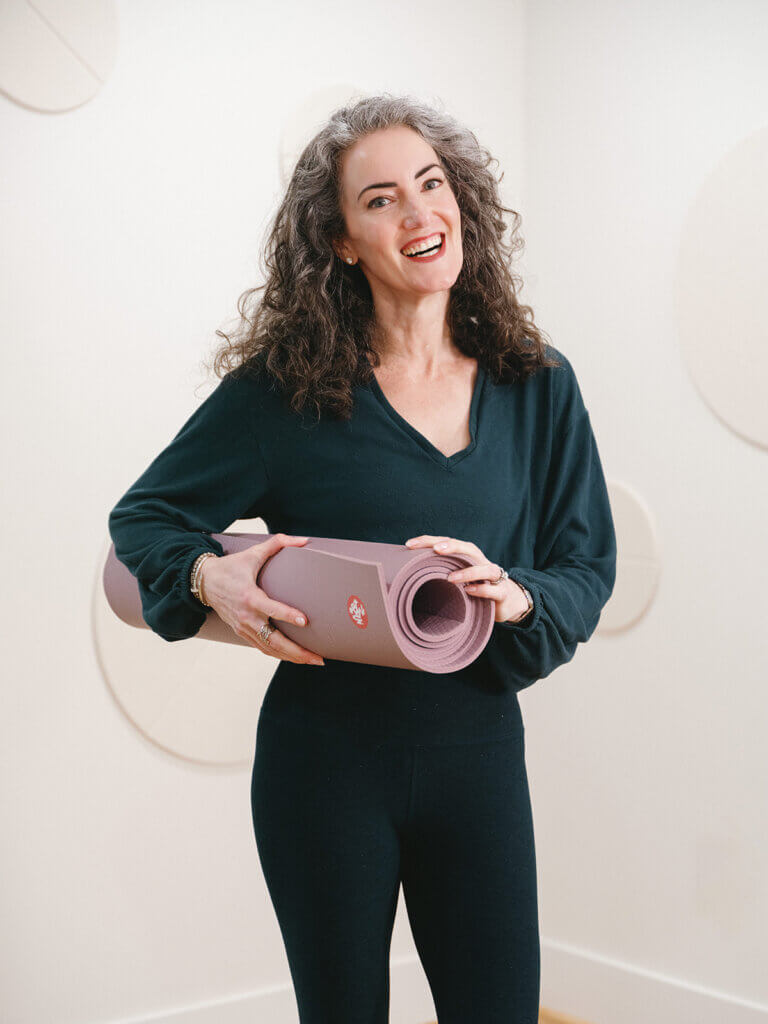
Joy and comparison can’t share the same breath—so how do you choose joy?
I don’t run much anymore, so most mornings you’ll find me walking—usually with my husband, often before the day has decided what it wants to be. We have a little game. When another walker comes toward us, we silently bet on whether they’ll say hello: thumbs up if they do, a mock thumbs-down if they don’t, like Joaquin Phoenix surveying the arena in Gladiator.
It sounds petty. It’s actually a joy practice. All we really want is for someone to look up and say hi—and when they do, it makes the whole walk. That small lift, delight in a stranger’s kindness, is one of the things my co-author Alexandra DeSiato and I wrote a whole book about. Yoga calls it maitri.
In the newest episode of the Yoga Teacher Confidential podcast, Alexandra and I read from Yoga Off the Mat and talked about the two forces that shape almost every ordinary day: comparison and fear. Here’s how to practice with both this week.
Maitri: the antidote to comparison
Maitri is usually translated as loving-kindness, or friendliness—the practice of meeting other people, and yourself, with goodwill instead of judgment. It is the opposite of comparison, and the simplest version I know fits in three words: “good for them.”
Say it the next time someone’s good news lands in your feed. Say it when a peer announces the thing you wanted. Try to mean it. Wishing someone well costs you nothing, and your joy was never a fixed pie that their win takes a slice of. The more sincerely you can celebrate someone else, the more joy stays available to you.
When the scroll makes you feel behind
Social media is a comparison machine. It serves you everyone’s highlight reel and invites you to measure your ordinary Tuesday against it. Even there, the practice holds—double-tap, leave the comment, celebrate out loud.
There’s a meme I love: Lucille Bluth’s flat “good for her.” Online it reads as sarcasm. On the mat—and off it—I want to say it straight. Good for her. And good for me. Two things can be true. Someone else’s success and your own contentment are not competing for the same oxygen.
If comparison is a habit, maitri is the set of reps that rewires it. Make the scroll your cue: every time you feel the pinch of “I should be further along,” answer it with “good for them.” Do it enough and the reframe shows up already attached to the pinch.
Abhinivesha: the fear of the unknown
The other force we read about is abhinivesha—the deep, instinctive clinging to the familiar. It is the fear of change, of loss, of not knowing what comes next. It’s natural, and it’s also the thing that keeps us frozen when a small step would do.
You don’t have to feel ready. Courage is mostly action taken slightly before you feel like it—one email you’ve been avoiding, one hard conversation, one class taught a new way. Readiness tends to catch up once you’ve moved. If fear of getting it wrong is what keeps you stuck, it’s the same muscle I write about in building real confidence.
Repetition is where connection lives
The surprising part of taking yoga off the mat is that connection rarely comes from novelty. It comes from repetition—the same morning walk, the same inside joke Alexandra lands every Monday, the same greeting offered to the same neighbors.
Repetition is underrated in teaching, too. Students don’t need a brand-new sequence every week to feel cared for; they need the comfort of the familiar done well, which is exactly why repetition beats novelty. The reps are the relationship.
Why I like talking about endings
We also wandered into death—because thinking about endings is one of the surest ways to enjoy the present. When you remember that the walk, the class, the conversation won’t last forever, you tend to show up for it more fully. Abhinivesha loosens its grip a little, and joy gets some room.
Take it off the mat
You don’t master maitri and courage the way you master a pose. You practice them in small moments: the feed, the doorway, the next thing you’re afraid to start. Pick one this week and practice it on purpose.
If you’d like to practice together, Alexandra and I are hosting a free live book talk on Thursday, July 16 at 2 p.m. ET inside the Zone, the free community at Comfort Zone Yoga®. We’ll read more from Yoga Off the Mat, take your questions, and talk about bringing the practice home. Join us in the Zone.
And if the book has helped you—or you think it might help someone else—grab your copy of Yoga Off the Mat. If you’ve already read it, a quick five-star review on Amazon or at your favorite bookstore, or a request that your local library carry it, does more than you know to put it in the right hands.