
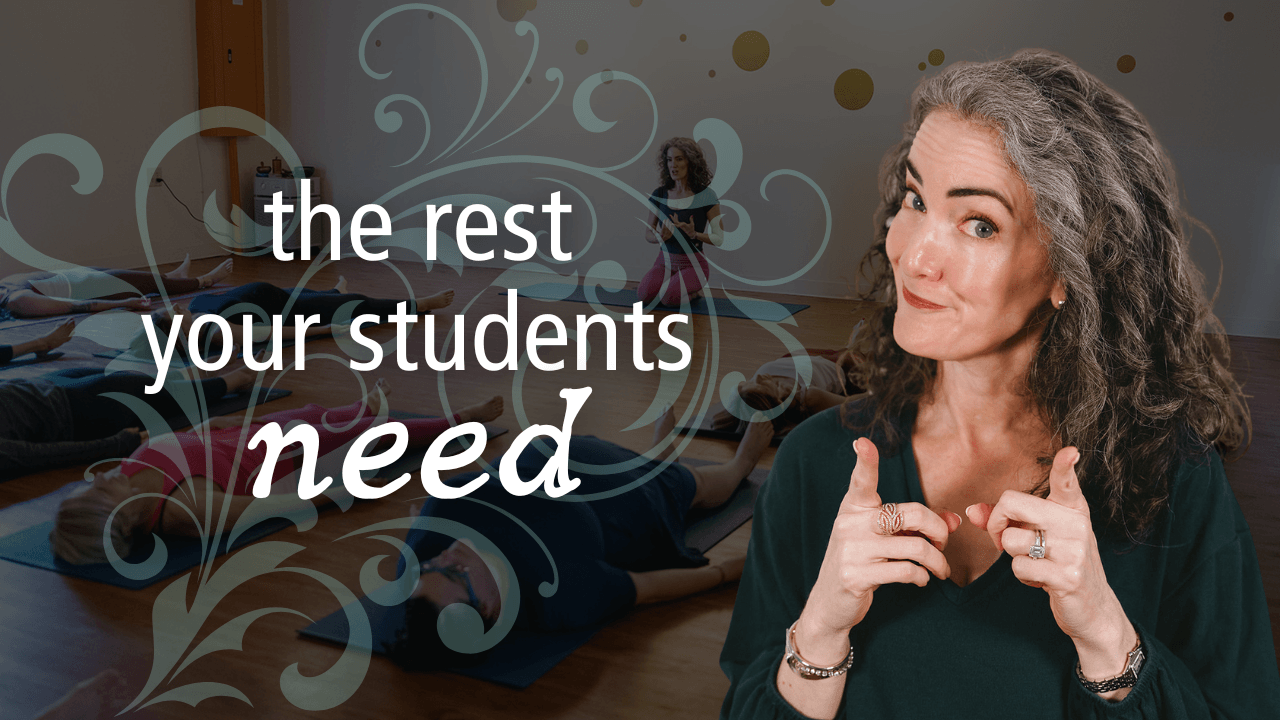
The first time I felt true rest, I wasn’t trying to. I was deep in Ironman training, carrying the kind of fatigue that made me look forward to dentist appointments—because they meant I got to lie down for forty-five minutes. I signed up for a restorative workshop mostly because I was that tired. About ten minutes into legs up the wall, two things happened: the entire outline for my book The Athlete’s Guide to Recovery dropped into my head, fully formed, and I realized I’d had no idea this state was even available to me for free.
That was the moment I understood restorative yoga isn’t a softer version of another practice. It’s a different category of work. And the difference between a class that says “rest” and one that actually restores comes down to how well you understand the nervous system you’re trying to talk to.
Telling students to relax doesn’t relax them
Here’s the pattern I see in teachers brand new and twenty years in alike. You love the idea of restorative yoga. You prop everyone up, dim the lights, tell the room to relax . . . and then you wait. Students fidget. Some fall into a heavy half-sleep that looks more like collapse than rest. They leave saying it was nice—but they’re not coming back hungry for more.
The thing that’s off sits right at the foundation. The nervous system doesn’t respond to verbal instructions. It responds to conditions.
This is the piece most of us somehow picked up wrong along the way: restorative yoga isn’t a vibe. It has a specific physiological target—the parasympathetic nervous system, the rest-and-digest side that turns down cortisol, slows the heart, softens the breath, and gives the body room to repair. If you’ve ever wondered exactly where it sits next to its cousins, it’s worth getting clear on the difference between gentle, yin, and restorative yoga.
Your students live in the other gear
Most of your students arrive in sympathetic mode. They drove to class answering work emails in their heads. Even in a slow flow, even in a long hold, there’s still a layer of effort running underneath. Restorative is meant to be the practice where all of that finally drops—but that drop doesn’t happen on command. It happens when the body trusts it’s safe enough to let go.
Which completely reframes the job. You’re not leading anyone anywhere. You’re building the conditions and letting each nervous system downshift on its own timeline. Your own steadiness is part of that setup, too—it’s the same principle behind nervous system co-regulation in any class you teach.
Five things that make restorative actually restorative
1. Set expectations before they walk in
Satisfaction equals expectations minus perception. If your class description says “gentle yoga with props,” students arrive expecting gentle yoga. Be specific about what restorative is and isn’t: three to five deeply supported shapes, held fifteen to thirty minutes each, with the explicit goal of doing nothing.
2. Build the conditions
Soft, warm, dark, slow. Every surface cushioned. The room warmer than usual—aim for the upper seventies if you can control it. If a student isn’t sure whether they need the extra blanket, the answer is yes. Tell them to take the upgrade.
3. Sequence with a framework, not a Pinterest board
I use the same lens I use everywhere: the 6–4–2 sequencing framework—six moves of the spine, four lines of the legs, two core actions. In a restorative class you won’t hit all of them, and you don’t need to. A fold, a gentle backbend, and a pair of twists is a complete meal. Less, held longer, beats more held shorter every time.
4. Hold space without filling it
This is the one that takes the most practice. In a fifteen-minute hold, the silence feels enormous and every instinct says talk. Don’t. Your job is to stay present, scan the room, catch the person who needs a small adjustment, and otherwise be a steady, settled edge to the practice. That presence is the teaching.
5. Mind the exit
A student who’s genuinely dropped into parasympathetic rest cannot bolt upright at the end. Bring them back the way you’d bring someone out of savasana—slowly, in stages, with permission.
Why this matters more every year
The world your students walk into is not slowing down. The capacity to access rest—to know what it feels like and find the door back to it—is becoming one of the most valuable things a yoga teacher can offer. Restorative isn’t a fluffy add-on to your schedule. It might be the most relevant thing you can teach right now.
Go deeper with me
I’m hosting a free hour on exactly this—Restorative Yoga That Actually Restores—on Thursday, June 25 from 2 to 3 p.m. Eastern, live inside The Zone, my free community for yoga teachers. RSVP here; if you can’t make it live, register anyway and I’ll send the recording.
Want a head start before your next class? Grab my free guide, Best Savasana Ever—the Six Supports that turn a flat savasana into a complete nervous-system reset.
And if you want the full framework with CEUs and a complete pose library, that lives inside my Fundamentals of Teaching Restorative Yoga course.

