
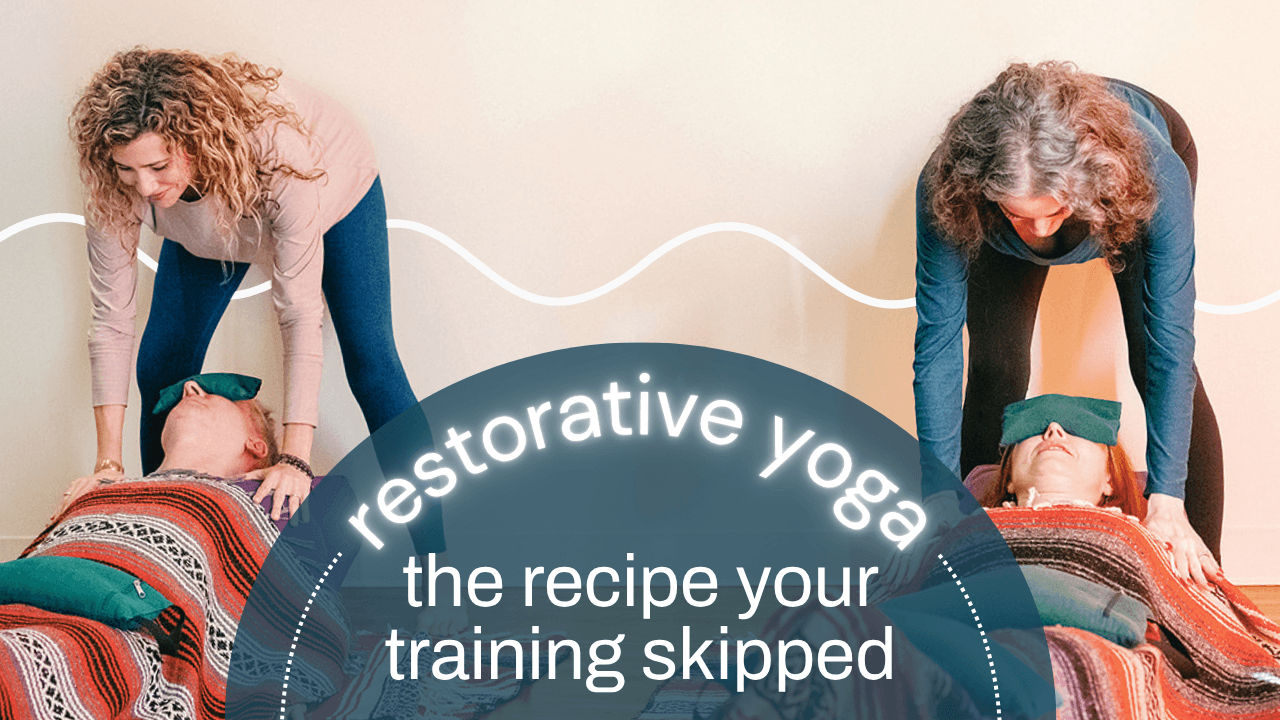
Your 200-hour training probably gave restorative yoga an afternoon—maybe an hour. Someone propped you up in a supported shape, dimmed the lights, and the curriculum moved on. Now your students keep asking for slower classes, the Thursday-evening restorative slot needs a teacher, and you’re left guessing at a practice your training barely touched.
You can learn to teach restorative yoga the same way you learned to chop an onion: as a craft skill, with a recipe to follow until you can season by taste. This post hands you the starting point—a free guide you can use in tonight’s class, plus a complete seven-video series that walks you through the entire framework.
Why restorative yoga deserves a spot on your schedule
Your students are overstimulated. They arrive with nervous systems stuck in overdrive, and most of them have no reliable way to downshift on their own. Restorative yoga answers exactly that problem: props create such complete physical support that the body drops into parasympathetic activation—the rest-and-digest state where digestion, immunity, and repair actually happen.
This is the secret power of yoga teaching—nervous-system co-regulation—applied deliberately, shape by shape. And because restorative asks nothing physically demanding of students, it welcomes every body in the room: athletes, beginners, your most burnt-out regulars. For you as a yoga teacher, that means a class format you can offer in studios, gyms, corporate settings, and workshops for decades to come.
What restorative yoga is (and what it isn’t)
Restorative yoga is a guided rest practice in which props create full body support so the nervous system can downshift. It isn’t a long savasana, it isn’t slow vinyasa, and it isn’t yin—yin loads the connective tissue with deliberate sensation, while restorative removes sensation entirely. If a student feels a stretch in a restorative shape, the prop setup needs adjusting.
If you’ve wondered how gentle, yin, and restorative actually differ, or where restorative ends and yoga nidra begins, the short answer is that restorative is its own category of work, aimed at the nervous system itself. That clarity matters: when you can define the practice in one sentence, you can pitch it to studio owners, explain it to new students, and stop apologizing for the silence and the long holds. Those aren’t gaps in your teaching . . . they’re features of the practice.
The framework: Six Supports, a few shapes, long holds
When you learn to teach restorative yoga, you’re learning three skills:
- The Six Supports. Knee support to release the lumbar in supine shapes. Head support to match the cervical curve. Arm support so the shoulders can drop. Weight, so the body knows it can stop holding itself. An eye covering to cut visual input. Warmth, because body temperature falls as the nervous system settles. These six prop choices are the building blocks of every restorative shape.
- The shape arc. A restorative class is three to five shapes held 15–20 minutes each: a grounded opener, a supported backbend, a twist or fold, and a fully supported savasana. Less, held longer, beats more held shorter every time.
- The long-hold skill. Your job during a fifteen-minute hold isn’t to keep talking. It’s to stay present, scan the room, offer a small adjustment where needed, and let the practice do the practice. That presence is the teaching.
None of this requires a naturally soothing voice or a particular personality. The same six supports apply in nearly every restorative shape—master them in savasana and you’ve mastered the foundation.
Start with the free guide: Best Savasana Ever
The fastest way in is through the one shape you already teach. Best Savasana Ever is a free guide to the Six Supports—six prop choices that turn a flat savasana into a complete nervous-system reset, with a video demo of the full setup.
Download it today, pick three of the supports, and use them in whatever class you teach tonight: vinyasa, gentle, athletes, chair. Watch what changes in the room.
Then watch the full seven-video series
I’ve just released a complete Teaching Restorative Yoga playlist on YouTube—seven videos that take you from clear definition to full framework to real-world proof:
- What Is Restorative Yoga? (And Why Most Classes Get It Wrong)—the one-sentence definition you can use with students and studio owners
- How to Teach a Restorative Yoga Class (Even If Your Training Barely Covered It)—the full framework: Six Supports, shape arc, and pacing
- Restorative Yoga vs. Yin Yoga: What’s the Difference? (For Yoga Teachers)—two practices, two different target systems
- Teaching Restorative Yoga Is a Prop Skill, Not a Personality Trait—why you don’t need to be “the calm type”
- Do You Need a Certification to Teach Restorative Yoga?—the honest answer
- I Don’t Have the Studio Set Up for Restorative Yoga—minimum-viable substitutes for every prop
- She Teaches Restorative at a Gym—Regulars Stay for Both Classes—proof the framework works in the real world
Start with the framework video, then follow the playlist in order:
Do you need a certification first?
No. Yoga Alliance has no separate restorative credential—your existing registration covers it. What you need is a framework, because more certifications won’t make you a better teacher; deliberate practice with a clear method will.
If you want the complete system—the full prop library with video demos, ready-to-teach class plans, cueing scripts, and twenty Yoga Alliance CEUs—my self-paced course Fundamentals of Teaching Restorative Yoga gives you all of it.
Your first step, tonight
Learning to teach restorative yoga starts smaller than you might think: download the free guide, choose three supports, and upgrade tonight’s savasana. The recipe carries you while you build the craft—and your students finally get the rest they’ve been asking for.

