
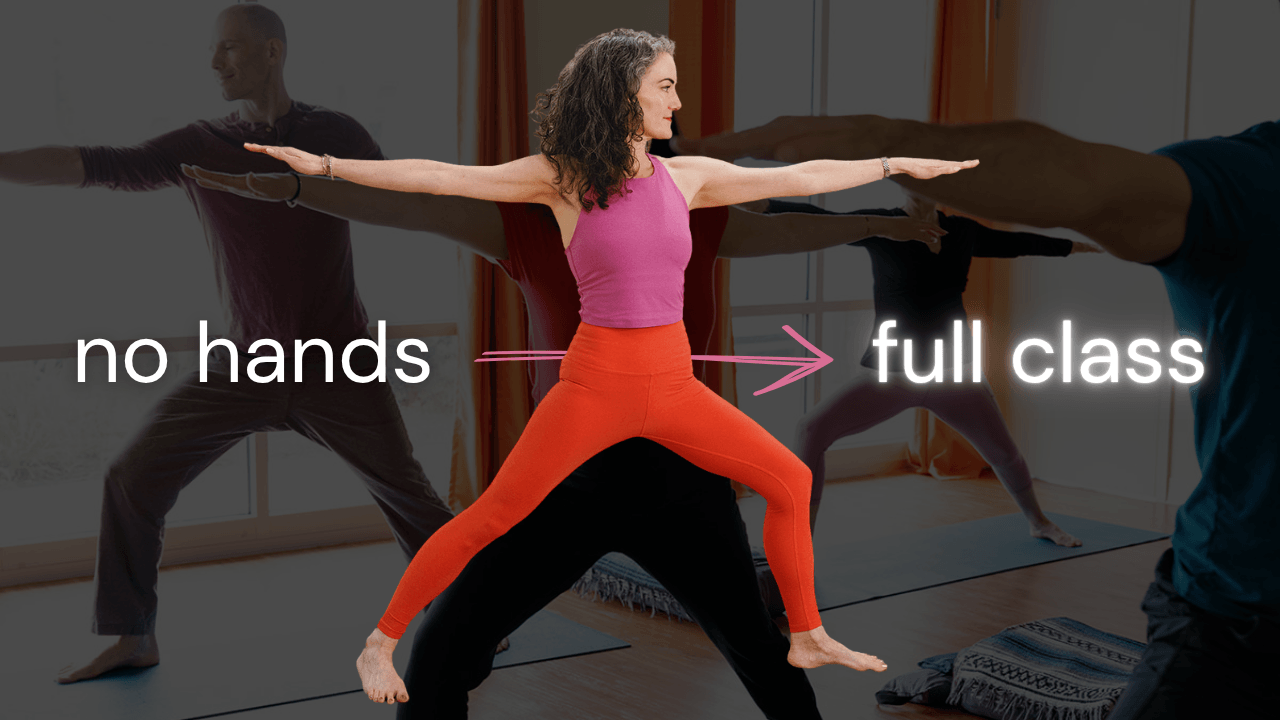
A student arrives with a wrist that won’t bear weight today. Or you’re teaching a beginners’ class. Or you’ve been demoing all week and your own hands need a rest. Whatever the reason, you want a complete class ready to go—one that moves through everything a balanced practice should, with no Down Dog and no Chaturanga in sight.
Good news: a hands-free flow can satisfy the entire 6–4–2 checklist across all four quarters of class. It belongs in your sequencing toolkit, right next to everything else you teach. Let me show you how to build one.
A Hands-Free Class Is a Real Class
Reach for a hands-free flow any time weight-bearing through the wrists isn’t the right answer for the people in front of you. Picture who walks through your door: the runner in for recovery, the student rebuilding after a wrist surgery, someone in their third trimester, a student with carpal tunnel or arthritis—and the teacher whose hands have done plenty this week. Every one of those is a hands-free moment, and none of them is a problem to solve. They’re bodies you get to teach.
This is also your chance to vary your sequencing on purpose. In my S.E.R.V.E. Method, you teach the same lesson plan long enough that students deepen, then change one element with intention so the next round teaches something new. A hands-free flow is one of those intentional variations—same architecture, different door.
The 6–4–2 Checklist, Hands-Free
When I plan any class, the through-line is balance. In The Art of Yoga Sequencing, I put it this way: bodies feel better when they move in many different ways and many different directions, with attention to balance between work and rest. That sentence is the whole recipe.
The way I check for that balance is the 6–4–2 checklist: six moves of the spine, four lines of the legs, two core actions—a checklist for balanced movement, not a pose-counting formula. Six moves of the spine means flexion and extension, side bending to both sides, and twisting both ways. Four lines of the legs means front, back, inner, and outer. Two core actions: stabilization and articulation.
What surprises new teachers is this: you can hit every one of those without an ounce of weight on a wrist. The hand-loaded shapes are one expression of those movements, not the only one. (For the bigger picture on building a balanced class that inspires confidence, start here.)
Build It in Four Quarters
Every class I teach has four quarters—opening, standing, mat, and finishing. Same architecture, hands free.
Quarter One: Opening
Begin seated or supine. Do cat-cow seated, with the hands resting on the thighs. Seated side bends, seated twists, supine knee circles. By the end of the warm-up you’ve already touched flexion, extension, side bending, and rotation, with no load on the wrists.
Quarter Two: Standing
This is where teachers worry, because so much vinyasa runs through Down Dog and Chaturanga. Strip those out and the whole standing repertoire is still yours: Mountain, Crescent, Warrior I and II, Reverse Warrior, Side Angle with the forearm on the thigh, Triangle with the bottom hand on the shin, Tree, Eagle. Use arm variations—cactus arms, eagle arms, hands at the heart—to keep the upper body awake, and link shapes with the breath to build the heat a sun salute usually provides. All four lines of the legs get worked, both core actions show up, and the hands rest. (Want the full rundown of what to teach instead of plank and down dog? I cover it here.)
Or choose any of these hands-free standing sequences:
Quarter Three: Mat
Supine and side-lying work is where hands-free shines. Bridge for extension, knees-to-chest for flexion, supine twists for rotation, reclined hand-to-big-toe for all four lines of the legs. Side-lying leg circles for the outer hip. Locust for back-body strength without a Chaturanga. You can check every box on 6–4–2 right here.
Quarter Four: Finishing
Restorative shapes, a breath practice, a long savasana. Same as any class. The hands have nothing to do.
Lay all four quarters end to end and you have a complete, balanced class. There’s nothing to climb toward, because we don’t climb—we move in many directions and keep work and rest in proportion. (Want more ways to keep a familiar structure feeling fresh? These sequencing hacks help.)
Three Pedagogy Moves
First, lead with capability. “Today we’re keeping the hands free” lands differently than “today we’re modifying because someone has a wrist issue.” Same shapes, completely different room.
Second, plan once and teach the same lesson plan for a month. The third week is where the magic shows up: you stop thinking about the next pose and start teaching the people in front of you. (More on why your students want repetition, not novelty.)
Third, stay in your seat as the teacher. Your job is to hold the structure and offer the cues; your students get to feel what’s true for them. You’re the expert on your teaching, and they’re the experts on their bodies.
Plan Once, Teach for a Month
A hands-free flow gives you the same balanced movement, walked in through a different door. Build one well and it stays in your toolkit for every student, every season, every reason you’ll ever need it.
If you’d like a full follow-along version of this practice—plus 200+ annotated sequences, every one tagged with the 6–4–2 checklist—they live inside the Prep Station, my monthly membership for yoga teachers.

