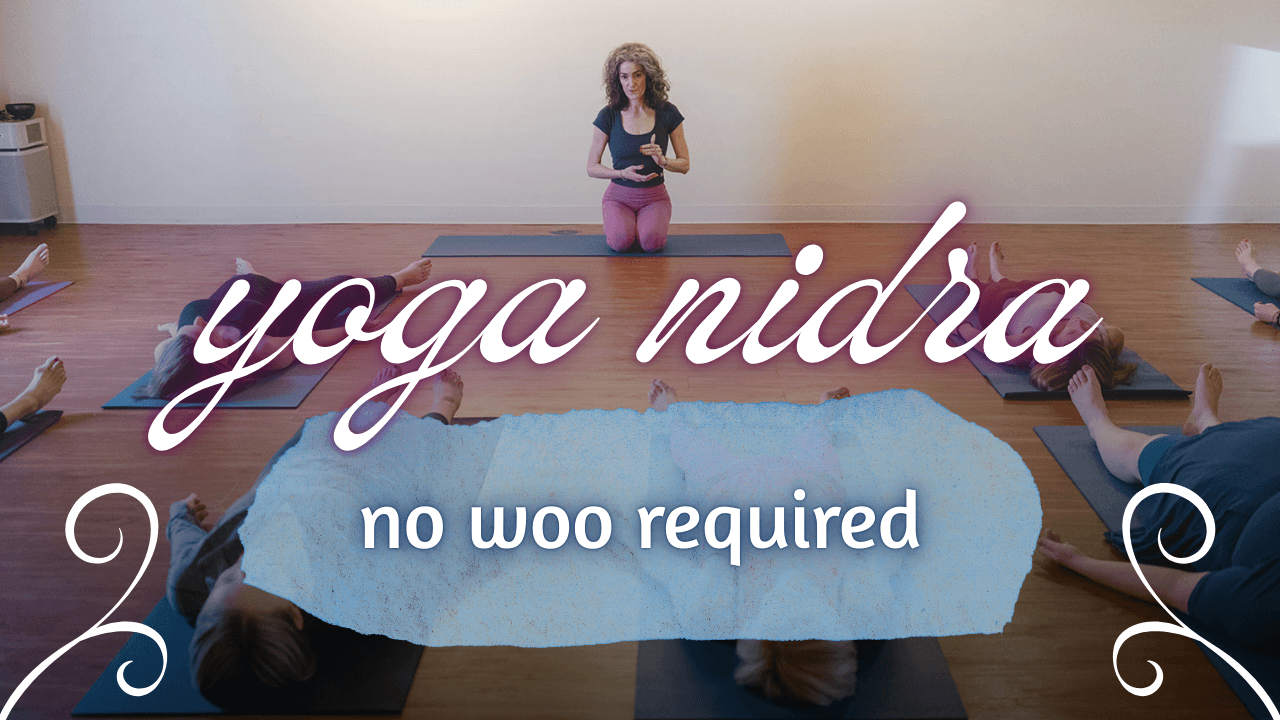
Yoga nidra is a structured guided-relaxation practice—not a mystical experience. A study published in the International Journal of Yoga found yoga nidra effective as a complementary treatment for anxiety, and a 2026 meta-analysis in the Annals of the New York Academy of Sciences confirmed measurable reductions in stress and depression across multiple trials. Teaching it well depends on craft, not cosmic consciousness.
Your Practical Teaching Style Isn’t a Disqualifier—It’s an Advantage
“I’m not woo enough to teach yoga nidra.” If you’re thinking that, my answer to you is: Good!!! Because yoga nidra doesn’t need woo. It needs structure.
If you’ve been scrolling through nidra content online—the cosmic consciousness language, the whisper-voice narrations, the essential oils and past-life references—and thought, “That’s not me,” I have good news. None of that is yoga nidra. That’s a stylistic choice layered on top of yoga nidra.
The actual practice follows a clear sequence: body, breath, emotions, visualization, stillness. There’s nothing inherently mystical about asking someone to notice their right thumb.
Where the “woo” association comes from
Yoga nidra has a branding problem. Search for it online and you’ll find language that sounds more like a guided astral journey than a structured rest practice. Some teachers guide nidra in a voice that sounds like they’re narrating a dream sequence. Some add sound baths, crystals, and references to the void.
Because so much nidra content is wrapped in a particular aesthetic, teachers who don’t share that aesthetic assume they don’t belong. That’s like saying you can’t cook Italian food because you don’t have a Tuscan kitchen.
What yoga nidra actually requires
The list is shorter than you’d think. Your students need to understand your instructions—“Bring your awareness to your right hand” works. “Allow your consciousness to dissolve into the etheric field of the right palm” doesn’t. Simple language wins.
Nidra follows a recipe: body, breath, brain, belly, bliss. Five steps in order. The structure is the practice—without it, you’re just talking while people lie on the floor. So slow down. Leave pauses. Let silence do some of the work. Your students need time to process each instruction before you give the next one.
And keep your voice steady. Your students need to feel safe, which doesn’t mean sounding like a meditation app. It means being consistent and reliable. Not second-guessing yourself out loud.
That’s the whole list. No spiritual persona. No crystals or singing bowls. Nidra is a framework. You bring your own style.
Why practical teachers have an edge
Here’s what I actually think: if you self-identify as “not woo,” you may be better suited to teach nidra than you realize.
The students who need nidra the most—the stressed-out, overstimulated, skeptical ones—are often turned off by mystical framing. They won’t sign up for “a journey to your inner cosmos.” But they will sign up for “a guided rest practice that helps you sleep better and think more clearly.”
Your practical language gets them in the room. Keeping it simple doesn’t water the practice down—it means the people who need rest the most will actually try it.
And the students who do love the mystical framing? They’ll get the same benefits from your version. The practice works because of its structure, not the language wrapped around it.
How to find your nidra voice
Teach it the way you teach everything else. If you’re clear and direct in your vinyasa classes, be clear and direct when the lights go down. If you wouldn’t say “surrender into the infinite” during a sun salutation, don’t say it in a nidra either. Say what you’d actually say: “Let your body be heavy. Let the floor hold you.”
A lot of teachers think they need to sound relaxed to teach a relaxation practice. You don’t. You need to sound steady and clear. Your students will relax because of the practice, not because you whispered.
Read a script to yourself. Record it. Listen back. You’ll find your rhythm, and it won’t sound like anyone else’s. That’s exactly right. If you’re not sure how this fits with your broader teaching voice, start where you are.
Try it yourself
If this resonates, grab my free five-minute yoga nidra script. It’s written in plain, clear language—read it out loud and see how it feels in your voice.
And if you want the full system—the complete recipe, annotated scripts, video lectures, and a custom GPT for building sessions in your own style—check out Teaching Yoga Nidra. Twenty Yoga Alliance CEUs, designed for real yoga teachers with full schedules.
You don’t need to be woo! You need to follow a recipe and say it like you mean it. If you’ve been sitting on the nidra sidelines because the vibe didn’t match—the problem was the branding, not you.