
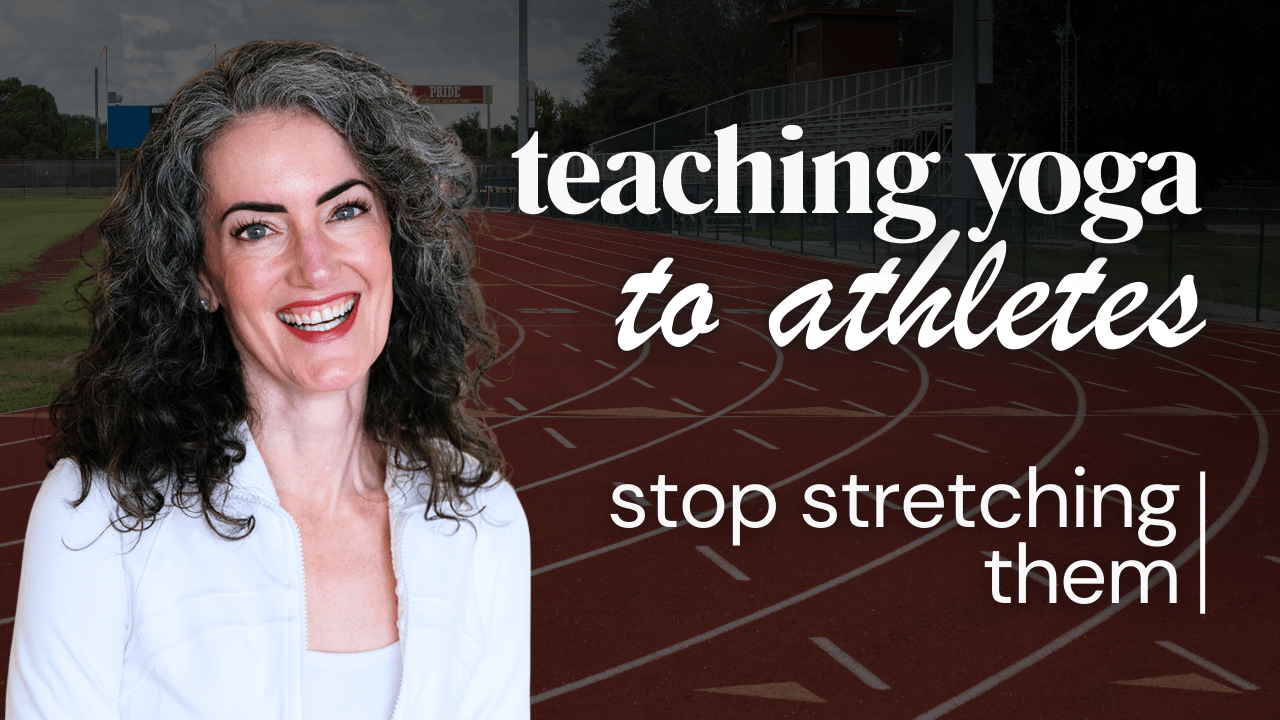
Why the Traditional Approach Backfires with Athletes
You see a runner who can barely touch their knees, let alone their toes. Your instinct says stretch those hamstrings. So you cue forward folds, emphasize lengthening, maybe bring out props to help them go deeper.
After twenty years of teaching athletes, from weekend warriors to Olympic competitors, I can tell you: that instinct is working against you.
Athletes’ hamstrings aren’t short. They’re strong and tight from repetitive use. A runner’s hamstrings are doing exactly what they’re supposed to do. They’re powerful, developed, and protective. Trying to force them to lengthen is fighting against their function.
When you push athletes into deep hamstring stretches, several things happen. They compensate by rounding their lower backs, which creates potential for injury. They feel frustrated because they can’t do what you’re asking. And they start to think yoga isn’t for them because they’re “not flexible enough.”
I learned this the hard way teaching football players. I’d cue forward fold, and these guys couldn’t even reach their knees. I’d watch them struggling, forcing, getting nothing beneficial from the practice. They’d leave feeling inadequate rather than supported.
So what do you do instead?
Three Shifts That Change Everything
Shift 1: Change Your Goal
The goal isn’t flexibility. It’s functional range of motion and the ability to release chronic tension. Those are different things, and the distinction changes how you teach.
Once you make that shift, everything about your class design follows: the poses you choose, the language you use, the way you measure progress.
Shift 2: Change Your Approach
Swap passive stretching for active release. Use gentle movement where you used to hold deep stretches. Build range gradually through repetition and breath rather than forcing it in one session.
Here’s what this looks like in a forward fold: Have them stand with soft knees, really soft, visibly bent. Hands on thighs or blocks at shin or knee height. The focus is on moving from the hips, not rounding the spine to get lower.
The question you’re asking them shifts from “How far can you go?” to “Can you maintain length in your spine while moving from your hips?”
They might only move a few inches. Good. They’re working in a range that actually helps them.
Shift 3: Change Your Cueing
Drop language like “deepen the stretch” or “take it further.” Try “find a sustainable position,” “notice where you feel sensation,” or “maintain length in your spine.” The words you use shape what athletes think success looks like. If you want to sharpen your cueing across the board, the 3-Cue Rule is a great place to start.
The Five-Step Framework for Working with Tight Hamstrings
Step 1: Use Bent Knees Generously
There’s no prize for straight legs. A bent-knee forward fold where the spine stays long beats a straight-leg fold where the spine rounds. Every time. Bent knees let athletes actually move from their hips, which is the whole point of the pose.
Step 2: Focus on Hip Hinge Patterns, Not Stretching
Teach athletes to move from their hip joints while maintaining spinal integrity. This is functional for their sport and actually accessible for tight hamstrings. Think about movements like a deadlift pattern—that’s the skill we’re building.
Step 3: Use Props Intelligently
Blocks aren’t just for beginners. They’re tools that allow proper form. When runners place their hands on blocks in a forward fold, they can maintain spinal length instead of collapsing to reach the floor. That’s better yoga, not easier yoga.
Step 4: Incorporate Active Movements
Have athletes move in and out of the position several times rather than holding a static stretch. Let them explore their range. The nervous system learns that the position is safe, and that sense of safety is what actually creates lasting change.
Step 5: Teach Self-Regulation
Give athletes permission to modify based on how they feel. “If your hamstrings feel worked but your spine stays long, you’re in the right place. If you’re rounding your back to go further, come up until you can maintain length.”
This teaches them to listen to their bodies, and that skill transfers directly to their sport. Division 1 athletes actually value this more than you might expect.
What This Looks Like in Practice
Amanda Frayeh, one of the teachers I’ve trained, learned this lesson at a climbing gym. She was trying to lead climbers through traditional forward folds, watching them struggle and compensate. Her anatomical cues weren’t landing.
Then she shifted her approach. She started emphasizing hip hinge patterns with bent knees. She used blocks generously. She focused on maintaining spinal length rather than achieving depth. She taught movement rather than static stretching.
The change was immediate. Athletes stopped struggling. They could actually do what she was asking. Most importantly, they started feeling the benefits—better recovery, reduced tension, improved movement patterns. Today her classes are consistently full because she learned to meet athletes where they are rather than forcing them into shapes their bodies resist.
That kind of adaptability is what grows when you have a clear sequencing framework guiding your decisions, rather than guessing your way through each class.
The Takeaway
Tight hamstrings in athletes aren’t a problem to fix. They’re a reality to work with. Your job is to help athletes move better in their sport: find functional range, release chronic tension, and build body awareness over time.
Meet them where they are. Use bent knees generously. Focus on hip hinge patterns. Teach them to listen to their bodies. The athletes who come back week after week are the ones who feel competent in your class, not the ones you pushed into shapes they couldn’t hold.
Want the Complete System?
If you want the full system for working with athletes’ bodies, including how to adapt traditional poses, what language to use, and how to build a sustainable income teaching this population, I’ve created a free workshop: How to Double Your Income Teaching Yoga to Athletes.

