
In this post
- How to theme your yoga class when bandwidth is low
- Why theming matters even when it is simple
- Three 5-minute ways to theme your yoga class
- The “What? So What? Now What?” arc
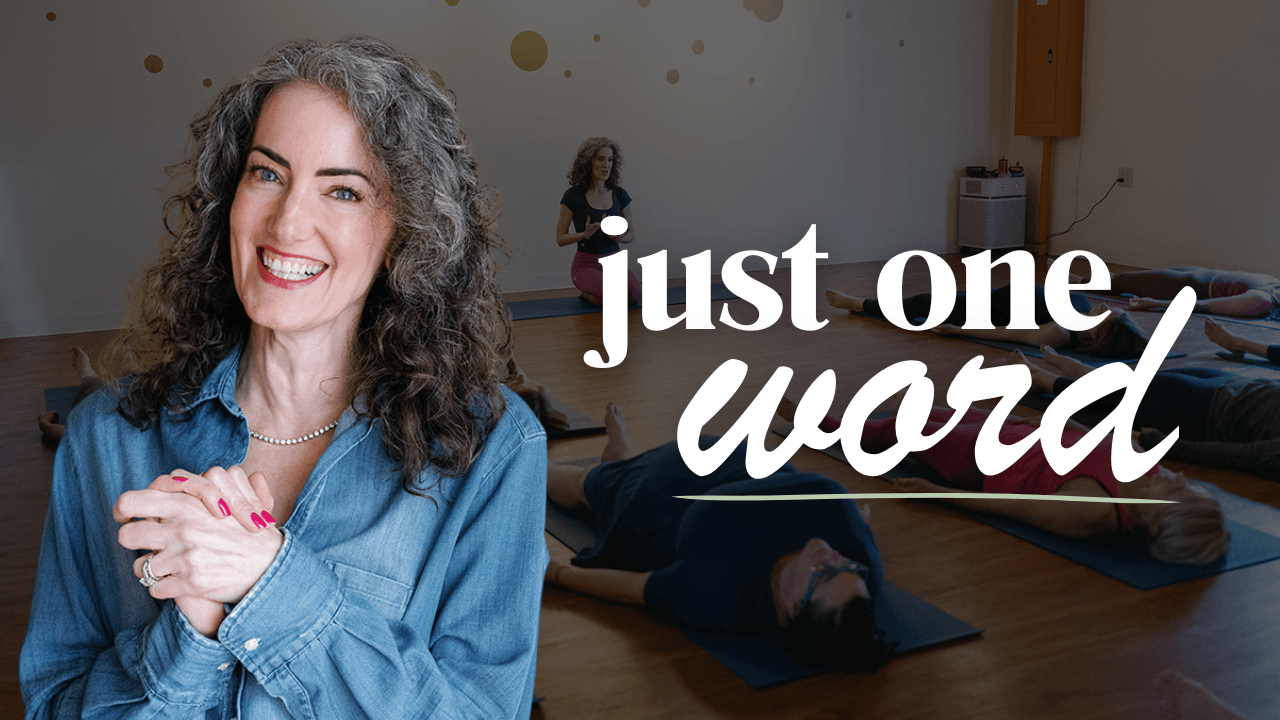
- Why one word is enough
How to Theme Your Yoga Class: You Already Have Everything You Need
How to theme your yoga class without overthinking it is a skill—and it is simpler than most of us make it. I used to change my class theme every single week. Sometimes twice a week. I’d sit down Sunday night, stare at a blank page, and think: What profound thing am I going to say tomorrow?
The template from Teaching Yoga Beyond the Poses asks you to think about quotes, playlists, movement cues, stillness cues, a closing reflection. And all of that is wonderful—when you have the bandwidth for it. But some weeks, the bandwidth just isn’t there. That is when knowing how to theme your yoga class quickly actually matters. And when theming feels like a research project, most of us do what’s easiest: skip it entirely.
Here’s what I’ve learned after 20-plus years of teaching: the problem isn’t that you don’t care enough. The problem is that you care so much about yoga that theming starts to feel like it needs to be capital-B Big and capital-I Important. It doesn’t.
Theme Your Yoga Class With a Thread, Not a Thesis
Think of your theme as a single thread running through your class. Sutra literally means thread. Ariadne gave Theseus a thread to navigate the labyrinth. And if you’ve ever watched a line of preschoolers holding a rope on a field trip, you’ve seen the same principle: everyone has something to hold onto.
That’s all your students need. Something to hold onto from centering to closing.
Four touchpoints. That’s the whole structure:
- Centering: Introduce your word or question
- Movement: Weave it into a cue
- Stillness or transition: Touch it again
- Closing: Tie it up in a bow
You’re not delivering a dharma talk. You’re stitching a thread through the cloth of your class—four loose tacks that keep everything connected. With practice, those four become eight, then sixteen. But four is where you start.
Why it matters (even when it’s simple)
A theme turns “hold this pose” into “notice what happens when you stay.” It turns movement into story. And we are wired for stories—we remember them, we carry them off the mat, we tell other people about them.
Here’s the part nobody tells you: having a theme makes your job easier. When you’re tempted to ramble during a long hold, your thread gives you somewhere to land. You come back to it, say something brief, and then get quiet. The theme does the heavy lifting so you don’t have to.
Three Ways to Theme Your Yoga Class in Five Minutes
1. Observation
Before you plan, take sixty seconds and ask: What have I been noticing lately?
Write down the first word that comes to mind. Spring growth. Patience. Heat. Release. That word is your theme. Done.
I once drove to the studio and came upon a rabbit running in panicked circles in the middle of the road while a group of people tried to help. That rabbit became my theme that night—about how we sometimes spin in circles creating our own suffering when what we really need is to stop, breathe, and get perspective.
2. Inquiry
Start with a question instead of a word. Where could you soften today? or What would it feel like to let this be enough?
The question itself becomes the thread. And it invites your students into their own exploration, which is more powerful than handing them your answers. Teaching yoga is a conversation—and questions keep that conversation alive.
3. Borrowed wisdom
Let someone else do the thinking. Alexandra DeSiato and I wrote 108 ready-made themes across Teaching Yoga Beyond the Poses and Volume 2. They’re recipes—and once you understand the recipe, you start cooking on your own.
If you’re in the Yoga Class Prep Station, you already get a monthly theme seed to work with. That’s another form of borrowed wisdom.
Theme Your Yoga Class With the “What? So What? Now What?” Arc
If you want a little more structure, this three-question framework gives your theme a complete arc:
- What? Present your idea with something personal and universal
- So what? Early in class, invite students to consider how it shows up in their lives
- Now what? Near the end, prompt them to take it off the mat
Three questions. One arc. Works every time.
One Word Is Enough (Yes, Really)
Patience. Softening. The exhale. Enough. Possibility. Lengthening.
Every one of those words could carry an entire class. You don’t need hours of research. You don’t need to be a philosopher. You just need one word and four places to touch it.
Your students want something to hold onto. You already have what it takes to give them that.
📥 Download the slides from this workshop
Go deeper
If theming is where you want to grow, Mastering the Art of Yoga Sequencing (MMM) includes a full module on theming, a Beverage Cart of 108-plus ready-to-use themes, and monthly live lesson-plan workshops where we practice together. And for planning your yoga class with confidence week after week, the Prep Station gives you the structure and the community to keep showing up.
My bestselling books Teaching Yoga Beyond the Poses and Teaching Yoga Beyond the Poses, Volume 2 offer a template for theming classes, all my best advice, and, together, 108 fully developed themes to use in your own class.
New book alert: Yoga Off the Mat—a modern, accessible take on yoga philosophy that Alexandra and I co-wrote—is now available wherever books are sold.
When you theme your yoga class this way—thread, not thesis—you give students a doorway into the practice without shutting out the ones who want to just breathe and move. The craft of learning how to theme your yoga class well is really the craft of restraint: saying less so your students can feel more. Every time I theme my yoga class, I ask whether the thread serves the people on the mats or just the teacher at the front of the room.

