Build a template, batch your month, and get your weekends back
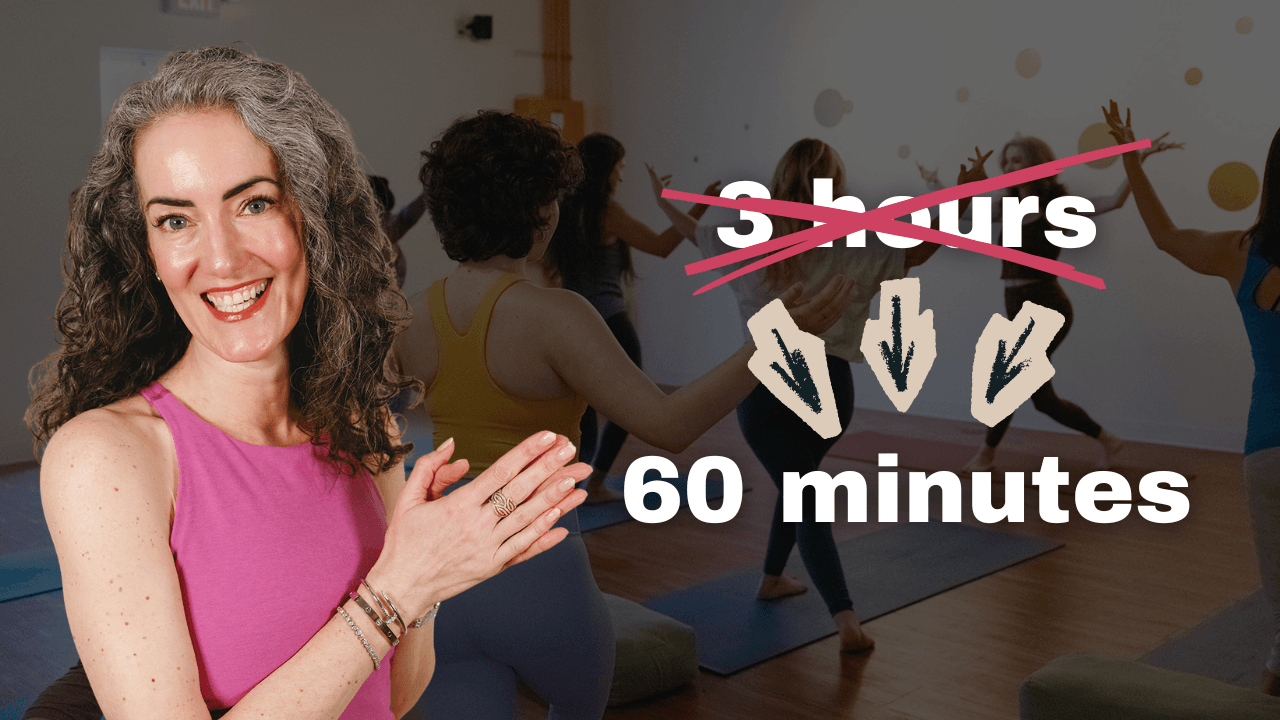
If it takes you three hours to plan a sixty-minute yoga class, this post is going to change your week, and quite possibly your teaching life. I have spent twenty-plus years teaching and training teachers, and I have watched brilliant, dedicated people lose an entire Sunday to one class plan—only to walk into the studio on Monday and throw half of it out.
The fix is not to grind harder. It is to plan smarter. Below is the structure I teach and use myself: why over-planning happens, the framework that gets you out of prep and into the room, and a one-hour monthly workflow you can start using this week.
Why over-planning happens (and why it is not your fault)
Most teachers over-plan because they are trying to invent everything from scratch every time. New poses, new themes, new openings, new closings. Every single class. Twenty years in, I can tell you it leaves teachers exhausted—and most students do not even want it.
There is a planning–confidence loop hidden inside that pattern. You over-plan because you are not confident, and you are not confident because you keep starting from zero. The way out is structure.
Your students need repetition
Students come to class to practice yoga, not to be surprised by a brand-new experience every week. Research on motor learning shows the body needs to practice movements repeatedly, across multiple sessions, before it can truly absorb them. A lot of the variation you are working so hard to provide is actually working against your students’ learning.
Repetition is craftsmanship. Why would you give yourself only a first draft of every class you teach?
Build a template
The single most powerful thing you can do to reduce planning time is to stop making structural decisions every time you sit down. Decide once, then reuse.
The framework I use is called 6–4–2: six moves of the spine, four lines of the legs, two core actions. It is a checklist for balanced movement, not a pose-counting formula. Once you have that architecture in place, the question shifts from what do I teach? to which poses fit here? That is a much smaller question, and it takes a fraction of the time to answer.
A few ways to put a template to work:
- Lead with a “greatest hits” sequence. Use poses your students already know and love as your base, and vary the theme, the cueing emphasis, or the featured pose from week to week.
- Rotate three to four skeleton sequences. Your students will not remember they did a similar class eight weeks ago. You will. They will not.
- Separate learning from planning. Reading about yoga is not how to plan a yoga class. Sitting down with a framework and a blank page is. Treat them as two different activities, and put them in two different parts of your week.
Batch-plan a month at once
Instead of planning one class at a time, plan a whole month in a single sitting. It sounds counterintuitive—surely four classes would take four times as long? They do not. The hardest part of planning is not filling in the details. It is making the big structural decisions: theme, featured sequence, arc. When you batch, you make all of those decisions once, in one focused session, and then you are done with them. The week-to-week work becomes simple fill-ins, keeping consistency and sprinkling in just a little variety.
Your one-hour monthly workflow
- Block sixty minutes once a month.
- Choose a monthly theme or thread.
- Sketch the arc across four weeks (build intensity, then ease back).
- Identify your featured poses.
- Draft your skeletons and check them against 6–4–2.
Then each week, give yourself another fifteen minutes to finalize the upcoming class based on what you actually saw in the room the week before.
Teachers I work with have gone from half their weekend on lesson planning to twenty minutes per class—sometimes per month. The classes do not suffer. If anything, they improve, because the teacher walks in with energy left over to actually be present with the people in front of them.
That responsiveness—the ability to meet your students where they are—is what confidence looks like from the front of the room.
The good-enough class challenge
When a teacher comes to me overwhelmed by planning, the challenge I give them is this: do not try to plan the perfect class. Plan a good-enough class, and then teach it so well with so much presence that it becomes perfect for that room on that day.
That kind of confidence grows out of planning smarter, with a system you trust, and showing up rested enough to notice what your students actually need.
Your next step
If you want the sequences, frameworks, and templates I use and teach—plus a monthly live call where we actually work through planning together—come join the Prep Station. For $39 a month, you get 200+ ready-to-teach sequences, weekly content drops, monthly CEUs, and a monthly Snack + Chat with me on the third Saturday at 2 p.m. ET. Think of it as the luncheonette: quick, nourishing, practical support for the next time you sit down to plan.
For more on class planning—including consistency, batching, and surviving a sub assignment—listen to the Yoga Teacher Confidential podcast. And if you are ready to go deeper on sequencing as a craft, Mastering the Art of Yoga Sequencing is my six-month mentorship for teachers who want a real system, not another bundle of cues.