
One checklist, six starting positions, and a warmup you can teach for years
In 2013 I filmed a two-minute warmup from my belly on a studio floor, and it has been finding yoga teachers ever since: the six moves of the spine, prone. It’s the warmup I reach for first, and it’s the first thing I check when I look at any class plan, mine or a student’s. If the spine has moved every way it can move before the standing work begins, the rest of the class tends to take care of itself.
What the six moves of the spine are
Your spine moves in three planes, and each plane has two directions, which is where the six come from. In the sagittal plane (front to back) the spine flexes and extends: rounding and arching, cat and cow. In the frontal plane (side to side) it bends laterally, to the left and to the right. In the transverse plane (round and round) it rotates, twisting one way and then the other. Forward, back, side, side, twist, twist: that’s the whole list, and you’ve almost certainly taught all six without calling them anything.
There’s a seventh way the spine moves, and we practice it in yoga too: axial extension, where the skull and tailbone travel away from each other and the natural curves flatten a little, the way they do when you stand as tall as you can in mountain pose. I leave it off the checklist because it shows up on its own in nearly every upright shape, but it’s worth knowing it’s there.
One caution, because a list makes the moves sound tidier than they are. Nothing in the body operates in complete independence, so these six don’t happen one at a time in real life: a side bend has a little rotation in it, and a twist usually carries some flexion. That’s fine (it’s better than fine; it’s how bodies work), and what the checklist asks for is coverage across the whole warmup, not purity in any single shape.
Why a warmup should hit all six
I think of a class as a movement diet. A well-balanced diet covers the macronutrients (carbohydrates, fat, and protein) every day, in some proportion, because none of us can leave one out indefinitely and still function well. A well-balanced movement diet does the same with the three planes, and while nobody notices if you skip a plane for a class or two, skip it for a season and your students’ bodies have been eating the same two things over and over.
The warmup is where you serve the whole plate. A short sequence that takes the spine through all six moves prepares it for anything that follows, whether the middle of your class is standing poses, hip work, or a long slow floor practice. It also does something for you as the yoga teacher. Once the six are handled in the first five minutes, you’ve already met the spine’s share of the 6–4–2 checklist (six moves of the spine, four lines of the legs, two core actions, which is the structure underneath my book The Art of Yoga Sequencing and underneath every class I plan), and you can spend the rest of the hour on the legs and the core without wondering whether you forgot to twist anybody.
That’s also why I tell teachers to stop hunting for a new warmup every week. Cat-cow, a lateral child’s pose, threading the needle: most of the warmups you already know cover the six moves. The craft is in checking that they do, and then in repeating the ones that work until they live in your body and in your students’ bodies.
Six starting positions, one warmup
The reason I’ve filmed this warmup so many times is that the starting position changes who can do it. So over the years I’ve built a family of them, one for every home base, and I’ve gathered them into a single playlist of the six-moves videos. Pick by the room in front of you.
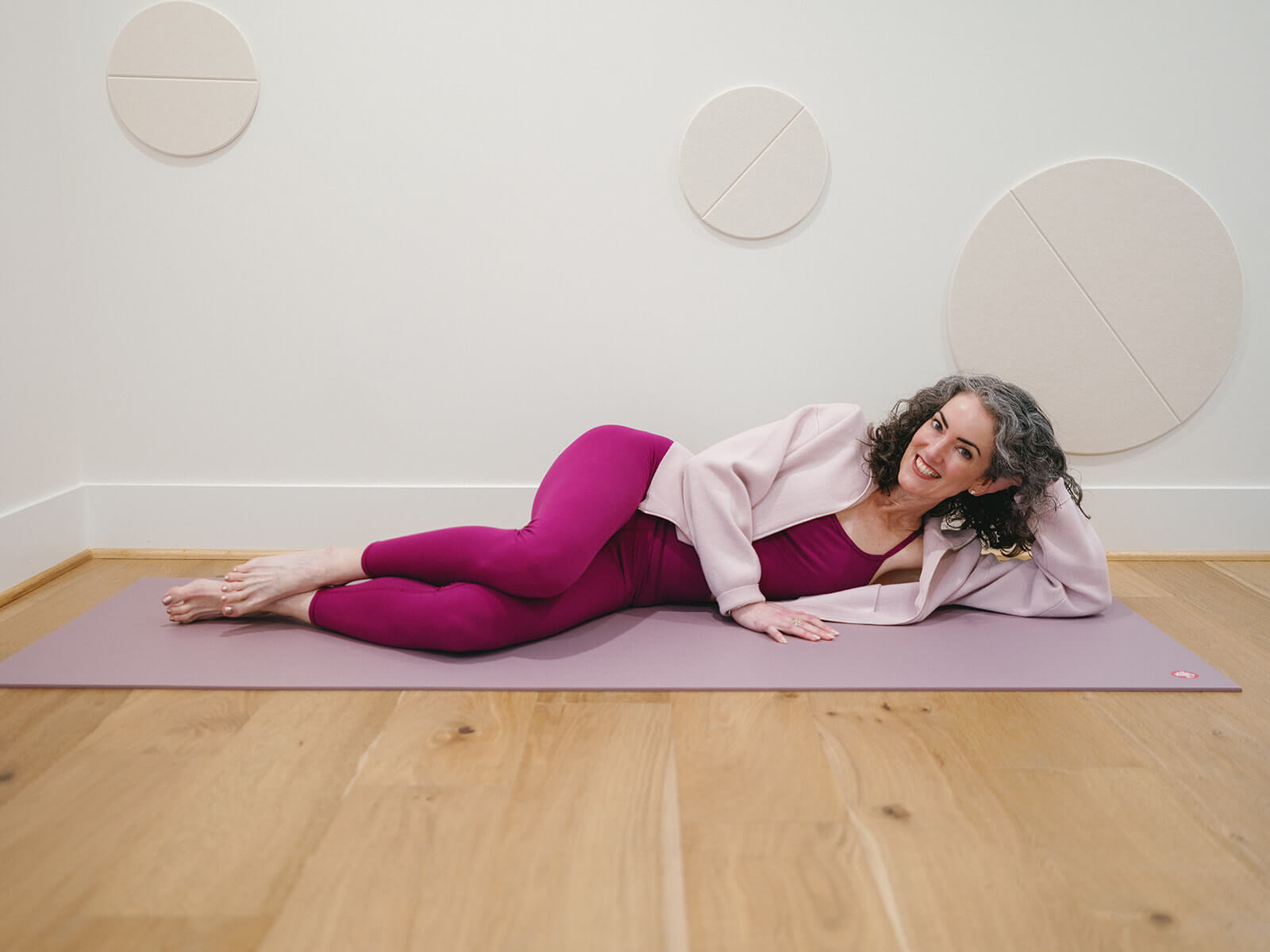
Prone, belly down
The original, and my go-to for settling a class that arrives scattered. Two minutes, no props, and the floor gives constant feedback about where the spine is. This is the one embedded above.
Supine, on the back
Knees toward the chest is the flexion, and the other five follow from there. There’s a one-leg version and a both-legs version, so you can choose by how much time you have and how much hip work you want folded in.
Standing
Two minutes, all six moves from the feet up, which makes it the warmup for a lunchtime class, a gym floor, or any room where getting down to the mat costs time you don’t have.
Kneeling
Cat-cow territory, so it’s the version closest to what most of us picked up in our own trainings. If you inherited a kneeling warmup somewhere along the way, this is the one that shows you it was already doing the job.
Seated, cross-legged or side saddle
A good start for a slow class, and for students who’d rather not bear weight on the wrists.
In a chair
All six moves with no floor at all, for chair classes, office visits, and anyone who would rather not get down and back up.
Most of them run two to seven minutes, every one of them covers the same six moves, and the only thing that changes from version to version is the ingredient list, which is exactly how a recipe works.
Practice it in your body first
Before you teach any of these, do the thing I ask of every teacher I mentor: follow the video yourself, then record your own voice guiding it and follow that. Teachers who skip this step teach from theory, and you can hear it in the cueing. Teachers who take the two minutes teach from their bones. Then teach the same warmup for a month. Your students won’t mind (mine tell me they like knowing what’s coming!), and by week three you’ll be watching the room instead of remembering what comes next, which is the entire reason to have a checklist in the first place.
What the checklist can’t do for you
Knowing the six moves of the spine is the start, and a list is exactly the kind of thing that feels like the whole answer. What changes your teaching is repeating a warmup until it’s polished, getting feedback on how you cue it, and having someone watch you fit it into a class that also covers the legs and the core. A teacher in my mentorship, Peggy, owned the book and still spent 150 minutes planning each class; it was the repetition and the eyes on her work that brought it down to 45.
If you’d like the warmups already sorted, and a fresh, balanced lesson plan every week to put them in, that’s what the Yoga Class Prep Station is for: the full sequence library, the planning tools, and monthly live calls with me, for $39 a month. And if you want to see how the six moves sit inside a whole class, start with the 6–4–2 framework, then watch me fill in the 6–4–2 worksheet in real time, and read why your students want repetition, not novelty. The warmup is where all of that begins.

