
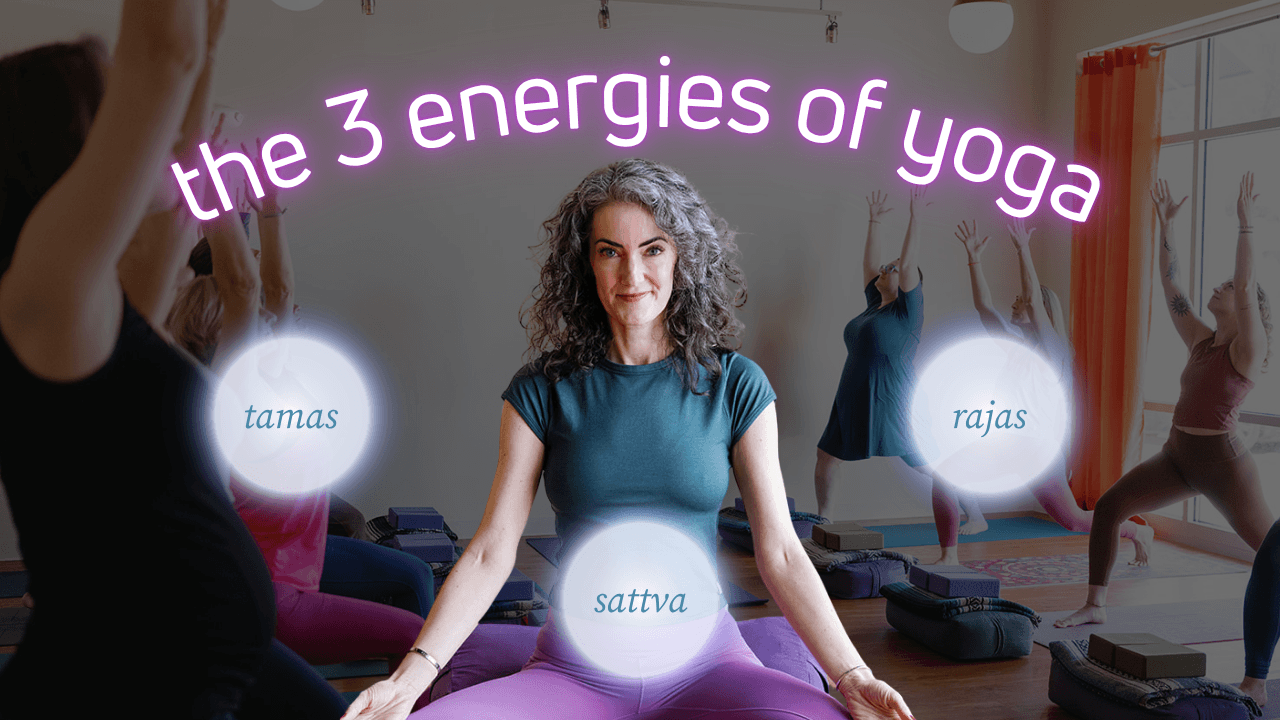
There’s a soundtrack playing inside you right now
Right now, three tracks are playing inside you. One is heavy—the energy that hits snooze for the third time. One is wired—the one drafting tomorrow’s class at 2 a.m. and scrolling for sequence ideas you’ll never use. And one is clear—the energy that shows up mid-class when your cues land, the room settles, and you’re not performing or overthinking. You’re just there.
Yoga philosophy has a name for these three flavors of energy: the gunas. They’re one of the most practical frameworks in the whole tradition—your students will grasp them in thirty seconds, you can use them to theme an entire class, and they’ll change how you understand your own energy as a teacher. Here’s how they work, and how to use them. (Want the full conversation? It’s Episode 88 of Yoga Teacher Confidential.)
Meet the gunas: tamas, rajas, and sattva
The gunas are three qualities of nature described in the Samkhya philosophy that underpins yoga. Everything in the material world is a blend of the three. They’re always present—what changes is the proportion.
Tamas is inertia: heaviness, dullness, resistance to change. It’s the fog after a big meal and the Sunday night when you decide to reteach last week’s sequence. Tamas isn’t bad—it’s what lets you rest and gives things stability. (In fact, your students often want that repetition.) But when tamas dominates, you stagnate.
Rajas is activity: movement, ambition, agitation. It’s the spark that got you into teacher training—and the restlessness that has you collecting sequences like recipes you’ll never cook. When rajas dominates, you’re busy without being productive.
Sattva is balance: clarity, harmony, presence. When sattva is dominant, you walk into the room and you know what to teach—not from a memorized script, but because you prepared and you trust it. Your cues are clean. Your presence is steady.
The goal isn’t to eliminate tamas and rajas. You can’t, and you wouldn’t want to. The goal is awareness—noticing which track is loudest, then choosing from that awareness. You’re not deleting the tracks. You’re learning to be the DJ.
How the gunas show up in your teaching
Think about the energy you bring to the front of the room. On a tamasic day, your teaching goes flat and your cues turn rote—and your students feel it, even if they can’t name it. On a rajasic day, you over-teach: too many poses, talking too fast, cueing the transition before anyone has arrived. On a sattvic day, there’s a presence your students recognize immediately. Those are the classes that build a waitlist.
Sattva isn’t a personality trait—it’s a practice outcome. You don’t will yourself into clarity any more than you can will yourself into your authentic teaching voice. You create the conditions for it.
Sattva begets sattva
The conditions are wonderfully mundane: what you eat, when you sleep, how much screen time you allow before class, and whether you did the prep or winged it. In Yoga Off the Mat, my new book with Alexandra DeSiato, we use the phrase sattva begets sattva: one clear choice makes the next one easier. Eat well, sleep better. Sleep better, plan sharper. Plan sharper, teach more present. It’s not magic—it’s alignment, and a trusted structure like the S.E.R.V.E. Method and 6–4–2 Framework gives that alignment somewhere to live.
Bring the gunas into your class (no Sanskrit required)
Here’s the simplest version. At the start of class, ask your students to notice their energy. You don’t even need the word “guna.” Just say: “Are you feeling heavy today? Wired? Or somewhere clear in the middle? There’s no wrong answer. We’re just noticing.” Pause and let them check in. That’s the gunas in thirty seconds.
From there, build the class around what you find. If the room is collectively heavy on a Monday morning, start slow and gradually build—coaxing sattva in with thoughtful structure rather than forcing energy. If the room is buzzing on a Friday evening, hold poses longer and let the silence do more work. (If you want to arrive clear before your students do, check your own guna state at the door first.)
You can even theme a whole series this way: tamas, rajas, sattva, then integration—becoming the DJ of your own playlist. Building classes that carry a clear arc like this is the heart of the work we do inside Mastering the Art of Yoga Sequencing.
Become the DJ of your own playlist
You have three tracks always playing: heavy, wired, clear. You can’t delete any of them, and you don’t need to. What you can do is notice which one is loudest—and whether the volume is serving you or running you. The practice is simple: notice, name, choose.
When you bring this to your students, you hand them one of the most accessible entry points into yoga philosophy there is. No Sanskrit. Just an honest question: “How’s your energy today?”
Pre-order Yoga Off the Mat (out July 14) to go deeper—Chapter 28 unpacks the gunas in full: pre-order the book.
And if you want a community of yoga teachers who take the craft seriously, join us in The Zone—my free community.

