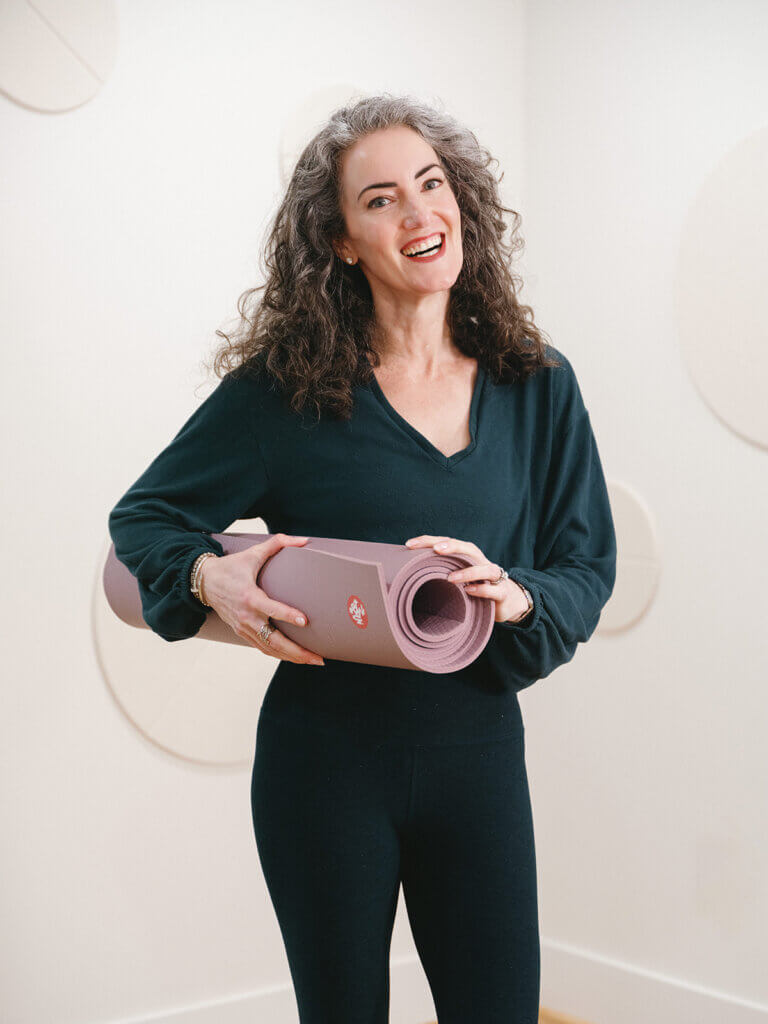
I have opened 99 episodes of my podcast, Yoga Teacher Confidential, with the same five words: “Can I tell you something?” I never sat down and decided that would be the opening line for two years running. It was a habit I picked up on the very first episode and then just kept, the way you keep a spice in your own kitchen because it works and you stop thinking to explain why. When I sat down to plan episode 100, that repetition was the first thing I noticed about my own two years of work, and it turned out to be the whole lesson.
The Show I Thought I Was Making
When I named this show Yoga Teacher Confidential, I meant the confidential part literally. I pictured something closer to a backstage pass: the things yoga teachers say to each other in the parking lot after class, the stuff nobody puts in a training manual. The audience was never in question—I knew from the first episode I was talking to yoga teachers, and that has not moved in ninety-nine weeks. What I got wrong was the register. I thought listeners wanted confessional. What they wanted was useful.
I found that out the ordinary way: I made both kinds of episodes and watched which ones people came back to. The dishy ones were fun to record. The useful ones were the ones teachers wrote to me about, forwarded to a friend in training, listened to twice with a notebook open. The show found its real shape when I stopped trying to be interesting and started trying to be useful, which, if you have listened for any length of time, is the same advice I give you about your own Tuesday night class.
What Two Years Actually Changed
Two things changed since episode one, and neither is a conversion story. The first is that I sold my studio. Running a brick-and-mortar yoga studio and thinking clearly about the craft of teaching are two different jobs, and for years I did both inside the same twenty-four hours. When one ended, the other got more room, and a good deal of what I have shared on this show since is thinking I did not previously have the hours to do.
The second change is smaller and more useful to you: I started writing the episodes down. Episode one is not a script—it is a handful of bullet points, one of which reads, in full, “students don’t care about YOU. They care about THEMSELVES.” Somewhere in the first few months I started drafting the whole thing in full sentences before I opened the microphone, and the effect was not what I expected. I assumed writing it out would make me stiffer. Instead, the episodes got shorter: when you write a thing down, you can see the places where you are circling the runway, and you cut them. Writing it down did not make me more formal. It made me briefer, which is a form of respect for whoever just handed me their commute.
The Zone Told Me What to Say
Over these two years I have also been building The Zone, my free community for yoga teachers, and it now holds more than three thousand yoga teachers. I did not build it to feed the podcast, but it has become the reason the podcast works: three thousand yoga teachers in one place will tell you exactly what they are stuck on, constantly, without my ever having to guess. When I asked members to tell me their biggest struggle, the answers were not subtle—“I don’t feel confident,” “I second-guess myself,” “I’ve been on the sidelines, thinking I wasn’t ready.” I did not invent those struggles. I answered them, episode by episode, which is the entire method: listen to what yoga teachers are actually stuck on, then make the episode about that.
Two Teachers, Two Years
Going back through two years of comments to build this episode, I noticed the same two handles showing up months apart, and when I put them in order, they turned out to be stories. One teacher commented in her first year of a two-hundred-hour training, midway through her very first class plan. Months later she was back, teaching her own weekly class. Months after that, she returned with a much more sophisticated question about running a workshop for people she knew socially. First class plan to her own weekly class to a room-management problem, in under a year, in comments she probably does not remember leaving.
The second story runs the other direction. A teacher wrote to say an episode had given her what she called a true ah-ha moment: that she had been missing the practice of turning her attention outward, toward the students actually in front of her. Months later she commented on a different episode, the one about knowing when to let a class go, on the day she taught her last class. She said she was grateful for what teaching had brought her, and thanked me for helping her plan classes her students had enjoyed. One teacher walking in the door of teaching. One walking out of it. That is what a hundred episodes actually buys you: not a body of work so much as a set of people you turned out to be useful to, most of whom you will never hear from at all.
Three Things Listeners Keep Telling Me
Three lessons keep coming back, because listeners tell me so directly. The first is that consistency beats variety: my episode on keeping the same sequence for weeks and changing only a fraction of it is, by a wide margin, the most commented-on episode of the show. One teacher wrote that keeping the same sequence for three weeks and changing twenty percent of it was the best thing she had done all year. If you want the fuller argument for why your students actually want repetition instead of a new plan every week, I have made the case at length.
The second is that the worry does not fully leave, no matter how long you have taught. A teacher with ten years of experience wrote that she had been so worried about being interesting that she struggled to trust herself, even after a decade. If that sounds familiar, building unshakeable confidence is a skill you keep practicing, not a finish line you cross once.
The third is service over performance. A listener named Katie wrote one line after an episode on social media that I still think about: “I think you just reset my nervous system.” Not because I said anything new—because permission is what most of us are short on. If teaching still feels hard some weeks even though you know better, you are in good company; I have written more about what to do when it still feels hard to teach yoga.
The Advice I Have Been Taking Without Saying So
I have been running my own advice on this podcast for ninety-nine weeks, and until this episode, I never said so out loud. Same opening line, same shape, one topic swapped out each time, everything else held steady. That is precisely what I ask you to do with your own classes—pick a structure, keep it, change a fraction of it, and trust that the repetition is doing work you cannot see from the front of the room. The single most commented-on episode of this show argues that repetition beats novelty, on a podcast that has repeated itself every Tuesday for two years. Nobody got bored. You are allowed to stop reinventing your own class plan every week, too.
If you want the fuller version of this retrospective, including the parts I could only say out loud after a hundred episodes, listen to episode 100 of Yoga Teacher Confidential.