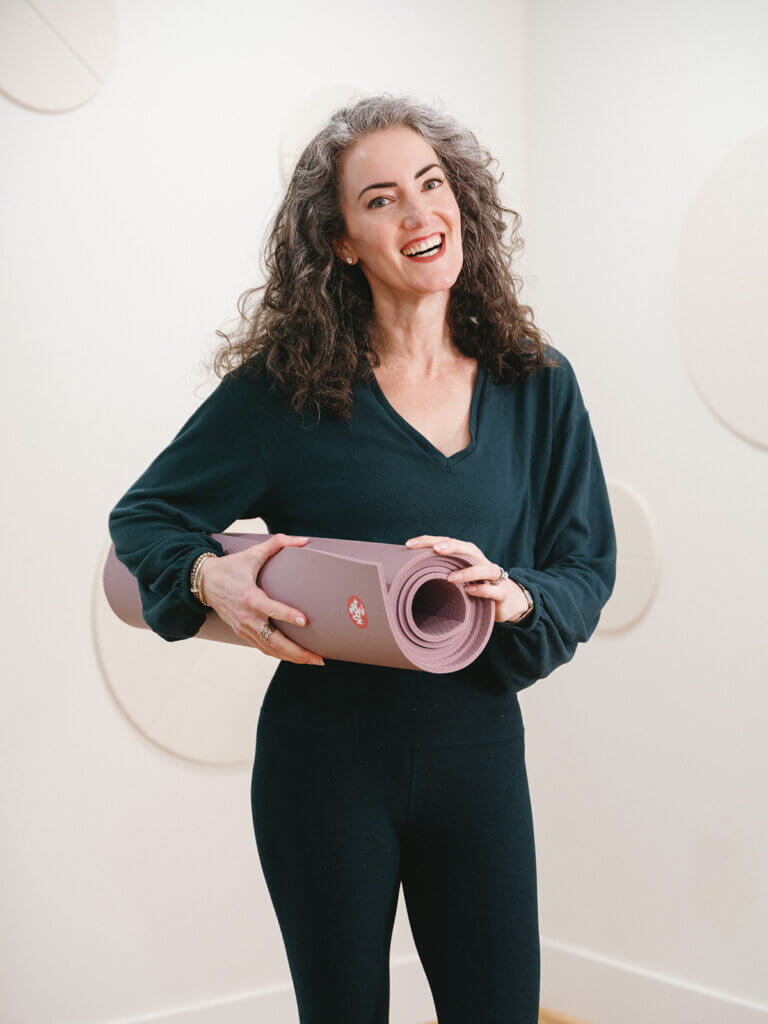
Nearly every yoga teacher I know is carrying around a someday workshop. It lives in the notes app, or on a sticky note, or in that folder of screenshots: the hip-opener workshop, the yoga-for-runners workshop, the stress-and-rest afternoon you’ve been meaning to offer for two years now. You’ve imagined the room. You may have even imagined the flyer. And then the loop starts: what if the topic’s wrong, what do I charge, what if nobody comes? The loop runs for a few minutes, the workshop goes back in the drawer, and “maybe someday” renews its lease for another season.
The distance between someday and a January workshop is shorter than you think. This post covers the thinking that has to happen before the planning: what a workshop actually is, how to choose a topic that wants to fill, and the honest truth about getting people in the door. If you want to do the planning itself with company, I’m hosting a working session on exactly this on Thursday, November 19, free in the Zone, my community of 3,400+ yoga teachers.
A workshop is not a long class
The structural question trips up almost everyone, so let’s start there. If you take your 90-minute class and stretch it across two and a half hours, you get a tired set of students and a vague sense that everyone would rather have taken the class. A class delivers an experience; a workshop delivers an experience plus understanding. Students walk out of class feeling better. They walk out of a workshop feeling better and able to say why, able to take something home and use it without you in the room. That understanding is what they’re paying the premium for.
So the architecture is different. A workshop breathes in cycles: you frame an idea, students experience it in their bodies, you make sense of it together, and then you build to the next idea. Explanation, experience, integration, repeat. There’s room for questions, which a class rarely has. There’s a beginning that tells people what they’re here to get and an ending that sends them home with it in hand.
Hold the principle for now: more understanding per minute, not more poses per minute. (We’ll map the segments and time stamps together at the November 19 session; that part is much easier to build live than to read about.)
Choose the topic with the hallway test
The topic question is where most someday workshops stall, and yoga teachers agonize over it in the wrong direction. They start from what would sound impressive. Start instead from the overlap of two circles: what you love teaching so much you’d happily talk about it for three hours, and what your students are already asking you about.
My litmus test is simple: what question do you keep answering in the hallway after class? The question that comes up again and again (about backs, about balance, about sleep, about hamstrings, about stress) is your students telling you, in plain language, what they would pay to understand. A workshop topic with a hallway question behind it markets downhill. A topic without one markets uphill, no matter how elegant it looks on a flyer.
If you can’t come up with at least three of your most common hallway questions right now, keep a note going after every class this week. I promise they’re there. Once you have them, pick one and draft a two-line description: what we’ll do, and what you’ll leave with. If you can’t say what students will leave with, the topic needs another turn of the crank, and that is a workshop test all by itself.
Filling the room is invitation, not marketing
Now the scariest part, the empty-room fear, and I want to reframe the entire problem. Filling a workshop is not a marketing problem in the way yoga teachers imagine. You picture needing to reach strangers: ads, algorithms, a following. You don’t. A workshop fills with 12 to 20 humans, and most of them are already in your classes. The people most likely to attend your workshop are the people who already know how they feel in your room.
Which means your marketing is mostly invitation. A line at the end of class for three weeks running: “That thing we touched on today? I’m doing a whole afternoon on it in January.” An email to your list, if you have one (and if you don’t, this is the reason to start one). And the personal ask, which outperforms everything: “You’ve asked me about this twice. I built the workshop for you. Will you come?”
One-to-one invitations feel almost embarrassingly small, and they are how rooms actually fill. Social media is the garnish. The hallway is the engine.
Getting the yes from your studio
You likely need a room and a yes, so a word about the studio. Studio owners say yes to workshops that serve their existing community and their calendar, because you’re bringing programming to their space and keeping their students in their ecosystem.
So pitch specifics: “I’d love to offer a two-hour workshop on yoga for low backs. I keep getting questions about it after my Tuesday class. Would a Saturday afternoon in late January work?” That’s a proposal an owner can act on. “Could I maybe do a workshop sometime?” is not.
And you might be able to offer a workshop somewhere other than a studio: a running store, a community center, or even outside (although probably not in January in the Northern Hemisphere).
And pricing, since it’s usually the last excuse standing: your price is a fact about the market, not a referendum on your worth. Look at what comparable workshops cost in your area, price within that range, and stop asking the fee to measure your value as a human being. Pricing anxiety is almost never about the number; it’s about what we’ve decided the number means.
Why November is the month
January and February are the best workshop months of the year. Resolution season fills rooms with people who want exactly what a workshop offers: a fresh start with structure and understanding attached. And studio calendars for January get settled in December, if not sooner. Plan in November, pitch as soon as you can (early December at the latest), and deliver in January. That’s the pipeline, and this week is the front of it.
My first workshop
I’m smiling as I write this, remembering my first workshop. I taught a workshop for athletes at a community center in my hometown of Winston-Salem, and my mom filled the room by telling all her friends from the gym, and all her fourth-grade students’ parents, to come. It went super well, in part because the crowd was so supportive (thanks, Mom!), and I suspect your first workshop, or your next one, will be easier to fill and sweeter to teach than you might be thinking.
Four steps this week
First, write down your most common hallway questions, in your students’ words.
Second, pick one and draft the two-line description: what we’ll do, and what you’ll leave with.
Third, ask your studio owner one question: “What’s your policy on teachers offering workshops?” You’re gathering information, not committing to anything. Getting that information, plus a little courage, is what closes the someday loop.
Fourth, come plan the rest with me. This month’s Comfort Zone Conversation is Thursday, November 19, free in the Zone at https://www.comfortzoneyoga.com. Bring your hallway question; leave with a workshop skeleton and a date on your calendar. And if you want the complete system, the planning templates, the timeline, and the promotional copy frameworks, the Workshop Workbook is $77 and does exactly what it says. It walks you through every step to generate, place, promote, and teach a fantastic workshop: https://sagerountree.com/the-workshop-workbook/
Your someday workshop has been patient long enough. Give it a January date.
I walk through all of this, including the calming word on pricing, in this week’s episode of Yoga Teacher Confidential, How to Plan a Workshop That Actually Fills: https://sagerountree.com/podcast